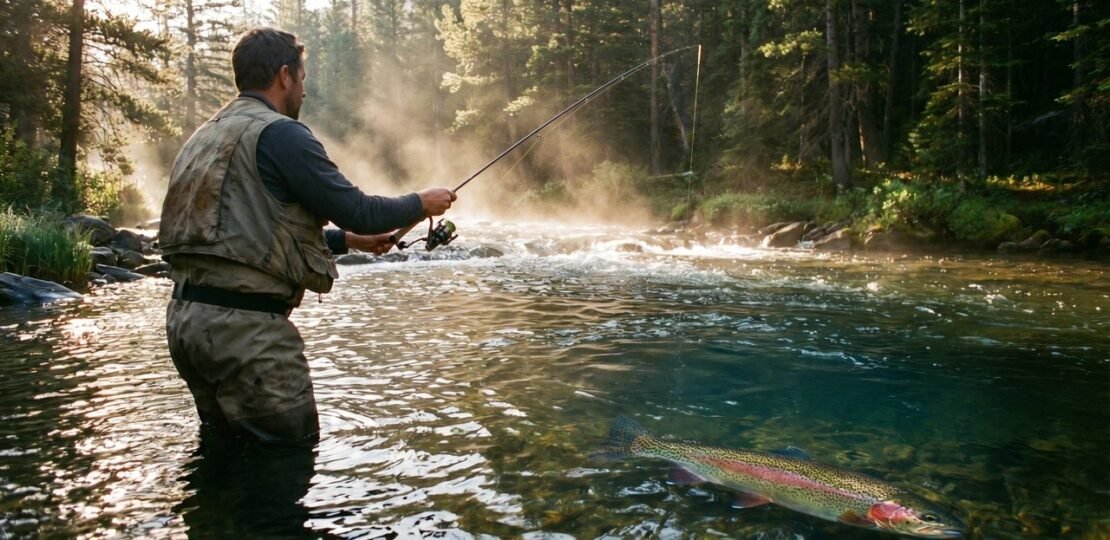
How to Catch Trout: A Complete Beginner’s Guide to Rainbow, Brown, and Brook Trout
Trout are the gateway fish for millions of anglers, and June is the sweet spot of the season across most of North America. Cold water, hungry fish, stocked ponds and wild streams. This guide walks you through everything from picking the right rod to tying your first bobber rig.
How to catch trout: Use a 6 to 7-foot light or ultralight spinning rod spooled with 4 to 6-pound monofilament. Fish stocked rainbow trout with PowerBait on a No. 10 baitholder hook under a small bobber, or cast a 1/16-ounce inline spinner like a Mepps Aglia. Target cold, clear water near drop-offs, inlets, or stream pools during early morning or evening for the best results.
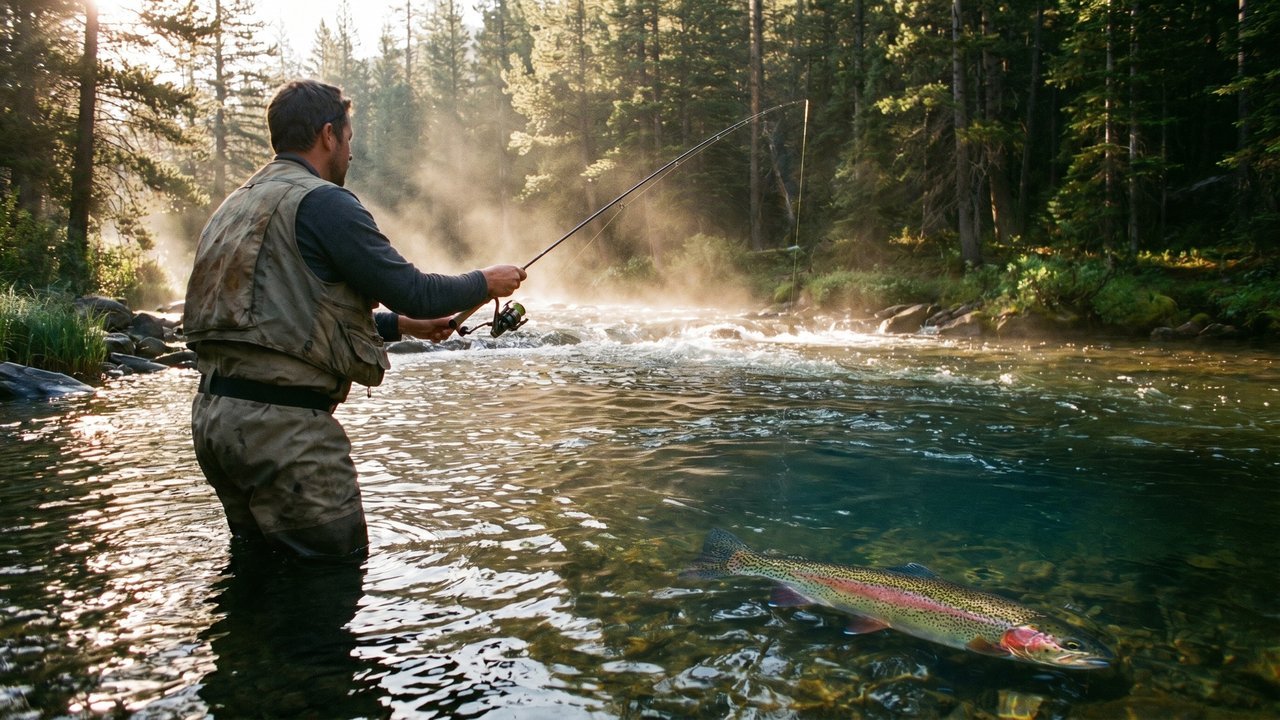
The 3 Trout Species You’ll Actually Encounter
North American waters hold dozens of trout and char species, but as a recreational angler you’ll mostly tangle with three. Each behaves differently, eats different things, and lives in different water.
Rainbow Trout
Rainbows are the workhorse of trout fishing. They’re stocked in lakes, ponds, and reservoirs across all 50 states, and they’re wild in cold streams and rivers throughout the West and Great Lakes region. A pink-purple stripe runs down their flanks, and they have small dark spots scattered across a silvery body.
Stocked rainbows average 9 to 12 inches and weigh under a pound. Wild rainbows in healthy rivers run 12 to 18 inches, with steelhead (sea-run or lake-run rainbows) pushing 5 to 15 pounds. They eat almost anything: insects, worms, eggs, small baitfish, and any scented dough bait you throw at them.
Rainbows are the easiest entry-level trout. They strike aggressively, hold in obvious places, and tolerate fishing pressure. If you’ve never caught a trout, this is the species that’ll change that.
Brown Trout
Brown trout are the wary, predatory cousins of rainbows. Native to Europe but stocked worldwide, they thrive in cooler streams, tailwaters below dams, and deep lakes. Look for buttery yellow flanks marked with black and red spots, often ringed in pale blue halos.
Browns get big. A 12-inch brown is a respectable stream fish; a 5-pound brown is a trophy in most waters; a 10-pound-plus brown is a once-a-season memory. They’re nocturnal feeders, more lure-shy than rainbows, and notoriously hard to fool in clear water.
If you catch a stream brown over 14 inches, you’ve earned it. They favor undercut banks, deep pools, log jams, and any structure that breaks current. Bigger browns eat smaller fish, so streamers, jerkbaits, and live minnows produce trophies.
Brook Trout
Brook trout aren’t technically trout. They’re char, like lake trout and Arctic char, but every angler calls them trout and that’s not going to change. Brookies are the prettiest fish in the woods: olive-green backs with worm-like vermiculations, red spots in blue halos, and white-edged orange fins.
They live in the coldest, cleanest water you can find. Mountain streams, alpine lakes, and headwater brooks across the Appalachians, Northeast, Upper Midwest, and Rockies. Most wild brookies you catch will be 6 to 10 inches. A 12-inch brook trout in a small stream is a giant. Lake brookies in places like Quebec or Labrador can hit 4 pounds.
Brookies are eager biters in remote water. They’ve often never seen a lure, so they hit small spinners, dry flies, and worms with reckless abandon. They’re also fragile: handle them gently and release them quickly if you plan to put them back.
| Species | Preferred Habitat | Typical Size | Best Season | Bait/Lures | Difficulty |
|---|---|---|---|---|---|
| Rainbow Trout | Stocked lakes, cold rivers, reservoirs | 9-18 inches, 0.5-2 lbs | Spring and fall, June peak | PowerBait, worms, inline spinners | Easy |
| Brown Trout | Cool streams, tailwaters, deep lakes | 10-20 inches, 1-5 lbs | Late spring, fall | Streamers, minnows, jerkbaits | Hard |
| Brook Trout | Cold mountain streams, alpine lakes | 6-12 inches, 0.25-1 lb | Late spring through summer | Small spinners, worms, dry flies | Easy to Moderate |
Where to Find Trout (Reading the Water)
Trout hold in specific spots that meet three needs: cold oxygenated water, cover from predators, and a steady food source. Find those three together and you’ve found trout.
Lakes and Ponds: Where Trout Hold
In stocked lakes and ponds, trout cruise. They don’t ambush like bass. They patrol open water and shoreline edges looking for food. Your job is to put bait in their path.
Focus on these zones:
- Inlets and outlets: Where streams flow in or out, the water is cooler and more oxygenated. Trout stack here, especially in summer.
- Drop-offs and points: Where shallow water meets deeper basins, trout transition through. Cast parallel to the drop.
- Submerged structure: Sunken trees, weed edges, and rock piles hold food and provide cover.
- Wind-blown shorelines: Wind pushes plankton and insects against the bank. Bait fish follow. Trout follow bait fish.
- Shade lines: On bright days, trout slide under docks, overhanging trees, or shaded coves.
Water depth matters more than you’d think. In spring and fall, trout cruise the top 10 feet. In summer, they sink to the thermocline, often 15 to 30 feet down in deeper lakes. A simple lake thermometer or fish finder tells you where the cold water sits.
Streams and Rivers: Reading Current
Stream trout face into the current and let the water deliver food. They hold in spots where they can ambush insects and baitfish while burning minimum energy. Learn to read these spots and you’ll catch fish on water that looks empty to a novice.
The high-percentage trout lies are:
- Pools: Deep, slow water below a riffle. Trout rest here and pick off food drifting from the fast water above.
- Riffles: Shallow, fast, oxygen-rich water over a gravel bed. Insects live in the gravel. Trout feed at the head and tail of riffles.
- Runs: The medium-speed water connecting riffles and pools. Trout hold mid-column in runs.
- Seams: The line where fast water meets slow water. Trout sit in the slow water and dart into the fast lane to grab food.
- Undercut banks: Where the current has eaten into the bank, creating a roof. Big browns live here.
- Behind boulders: Any obstruction breaks current. Trout rest in the calm pocket behind and to the sides of mid-stream rocks.
Approach upstream when possible. Trout face into the current, so they’re looking away from you. Wade quietly, keep a low profile, and cast above the lie so your bait drifts naturally into the strike zone.
Stocked Trout: Where They Go After Release
State agencies dump trout out of trucks into lakes and ponds, and those fish behave predictably for the first week or two. Right after stocking, they school tight near the release point, often in the shallows. They’re disoriented and won’t feed much for 24 to 48 hours.
By day three, they start to spread out and feed. Stocked fish gravitate toward inlets, shaded shorelines, and any structure that gives them cover. Most never figure out how to be wild, so they keep schooling and keep hitting bright, scented baits like PowerBait throughout their short lives.
Check your state agency’s stocking schedule. Most states publish exactly when and where they stock. The Oregon Department of Fish and Wildlife maintains a particularly useful weekly stocking schedule that other states model their reporting after. Show up the day after a stocking and you’ll often have ten fish in the cooler before lunch. For more agency-specific stocking and regulation information, the Oregon Department of Fish & Wildlife publishes thorough guidance worth bookmarking.
Your Trout Fishing Setup
Trout fishing doesn’t require expensive gear. A $60 spinning combo will catch as many trout as a $300 one if you fish it well. But there is a right balance of rod power, line weight, and terminal tackle, and getting it wrong makes everything harder.
Rod and Reel
For all-around trout fishing, we suggest a 6 to 7-foot light-power spinning rod with a fast or moderate-fast action. Light power has enough backbone to land a 15-inch trout but stays sensitive to a 9-inch nibble. The fast action helps you set the hook quickly when a fish hits.
For small streams and small fish, drop to an ultralight rod (5 to 6 feet, 2 to 6-pound line rating). For larger reservoirs where you might tangle with a 5-pound rainbow or a small lake trout, step up to a medium-light 7-footer.
Pair the rod with a 1000 or 2000-size spinning reel. Anything bigger is overkill. Look for a smooth drag (this matters more than gear ratio for trout), at least 4 ball bearings, and an instant-anti-reverse handle. Brands like Daiwa BG, Shimano Sienna, Pflueger President, and Okuma Ceymar all hit the budget sweet spot under $100.
If you want a complete walkthrough on matched setups, our trout rod and reel combo guide covers specific models at every price point, and our spinning reel for trout breakdown goes deeper on the reel side. For ready-to-fish packages we also keep a current spinning combo for trout roundup.
Line
Line choice is where most beginners overcomplicate things. Here’s the simple answer: 4 to 6-pound monofilament for almost everything. Mono stretches, which forgives jerky hook sets, and it floats, which keeps your bobber rigs working naturally. Berkley Trilene XL and Stren Original are the gold standards under $10 a spool.
For clear water and finicky fish, switch to 4-pound fluorocarbon leader (about 24 to 36 inches) tied to your mono mainline with a double uni knot. Fluorocarbon is nearly invisible underwater, which matters when targeting wild browns in skinny streams.
Braided line has a place for trout, but only as a mainline with a fluoro leader. The zero-stretch of braid telegraphs every tap, which is great for finesse jigging in deep lakes. Stick with 6 or 10-pound braid like PowerPro and add a 4-pound fluoro leader.
For deeper guidance on what to spool, see our best fishing line for trout writeup and our line weight guide for matching pound test to water type.
Terminal Tackle (hooks, weights, bobbers)
Terminal tackle is the cheap stuff that does the actual work. Stock these items in a small tackle tray and you’re set for almost any trout situation.
Hooks:
- Eagle Claw 181 baitholder hooks, sizes No. 8, No. 10, and No. 12
- Gamakatsu Octopus hooks, sizes No. 8 and No. 10 (for live worms and minnows)
- Mustad 92647 treble hooks, size No. 14 (for PowerBait specifically)
Weights:
- Split shot assortment: BB, No. 1, No. 3, No. 5 (Water Gremlin Green is reusable and removable)
- Egg sinkers: 1/8 oz, 1/4 oz, 3/8 oz (for sliding sinker rigs)
- Pencil weights: 1/4 oz (for stream drifting in heavier current)
Bobbers and floats:
- Thill Mini Stealth slip floats (small and medium)
- Plastic clip-on bobbers in 1-inch diameter
- Bobber stops and beads for slip rigs
Swivels and snaps:
- Size 10 or 12 barrel swivels
- Size 10 ball-bearing swivels with snaps (for spinners that can twist your line)
| Tier | Rod & Reel | Line | Terminal Tackle | Approximate Total |
|---|---|---|---|---|
| Budget (under $75) | Ugly Stik GX2 6’6″ Light combo ($55) | Berkley Trilene XL 4-lb ($7) | Plano starter kit with hooks, weights, bobbers ($12) | $74 |
| Mid-Range ($75-$150) | Daiwa BG MQ 2000 + St. Croix Triumph 6’6″ Light ($140) | Sufix Elite 4-lb mono + Seaguar Red Label 4-lb fluoro leader ($25) | Curated assortment with Gamakatsu hooks, Thill floats ($30) | $195 (premium budget) |
| Premium ($150+) | Shimano Stradic FL 2500 + G. Loomis IMX-Pro 6’8″ Light ($550) | Sufix Elite mainline + Seaguar Tatsu fluoro leader ($45) | Owner Mosquito hooks, Water Gremlin shot, Thill premium floats ($45) | $640 |
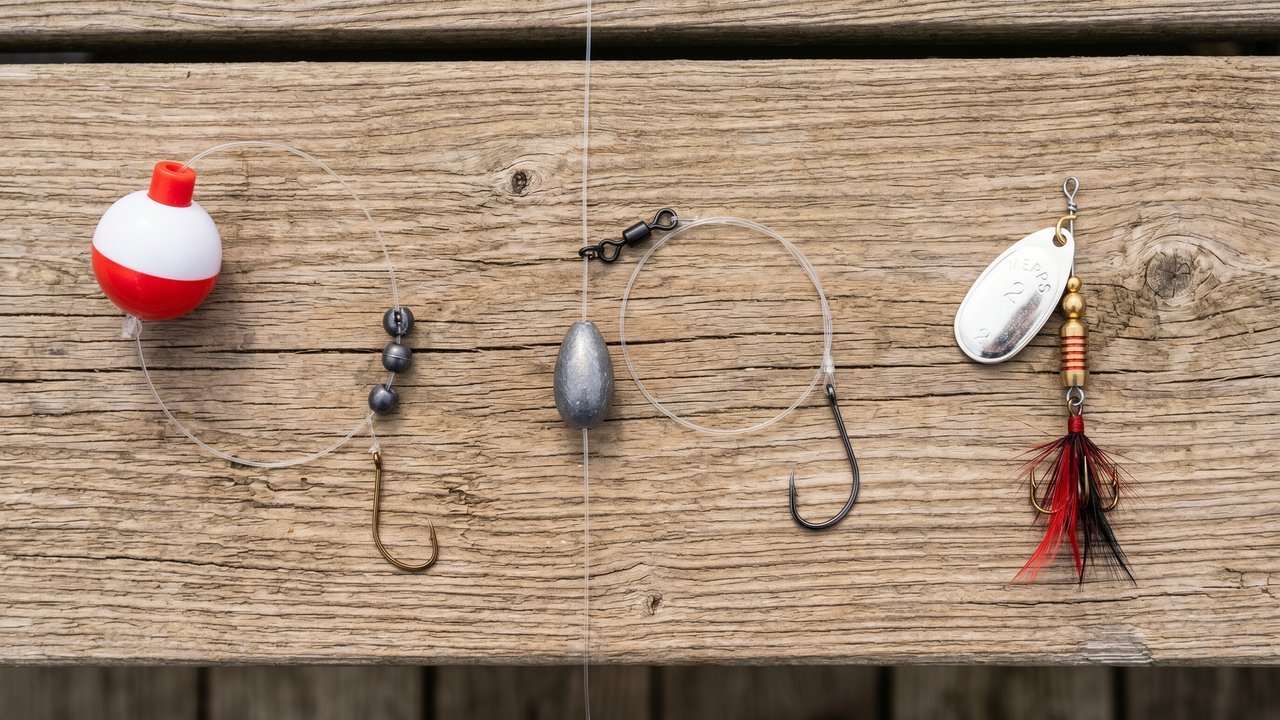
How to Rig for Trout: 3 Core Setups
This is where most beginners get lost. You bought a rod, you bought hooks, you bought bait, and now you’re staring at a tangle wondering how it all connects. Here are the three rigs that cover 95% of trout fishing situations. Master these and you’re set for life.
The Bobber Rig (Best for Still Water)
The bobber rig is the first rig most anglers ever tie, and for good reason. It works. It suspends bait at a chosen depth, signals strikes visually, and keeps your hook off snags on the bottom. Use it in lakes, ponds, and slow river pools when fishing PowerBait, worms, or salmon eggs.
For a clip-on bobber setup with bait suspended at a fixed depth:
- Tie a No. 10 or No. 8 baitholder hook to the end of your mainline using an improved clinch knot. Pass the line through the eye, wrap five times around the standing line, pass the tag end through the small loop near the eye, then through the larger loop you just created. Wet the line and pull tight.
- Pinch one or two BB-sized split shot onto your line approximately 8 to 12 inches above the hook. The split shot helps your bait sink and keeps the bobber upright.
- Clip a 1-inch plastic bobber onto your mainline. The distance between the bobber and your hook is your fishing depth. Start with 3 to 4 feet for stocked trout in shallow water.
- Bait the hook. For PowerBait, mold a marble-sized ball completely around the hook so the entire hook is hidden. For worms, thread a 2-inch piece up over the eye and let the tail dangle.
- Cast and watch the bobber. A trout bite looks like a sudden dip, a sideways slide, or the bobber laying flat. Reel slack, then sweep the rod sideways to set the hook. No giant hook sets needed on trout.
For deeper water, swap the clip-on bobber for a slip float. Tie a bobber stop and bead above your hook, then thread on a Thill slip float. The float slides freely until it hits the stop, letting you fish 8, 12, or 20 feet deep while still casting easily.
The Sliding Sinker Bottom Rig (Best for Rivers and Current)
When trout are holding deep, hugging the bottom, or feeding in current, you need to get bait down and keep it stable. The sliding sinker rig (sometimes called a Carolina rig in bass terms) does exactly that. It also lets a trout pick up your bait without feeling the weight, which means more committed strikes.
Here’s how to tie it:
- Thread an egg sinker (1/8 to 3/8 oz depending on current strength) onto your mainline. The line passes through the hole in the sinker so the weight slides freely.
- Thread a small plastic bead onto the line below the sinker. The bead protects your knot from the sliding weight.
- Tie a size 10 barrel swivel to the end of your mainline using an improved clinch knot. The swivel acts as a stopper so the sinker can’t slide down to the hook.
- Cut a fluorocarbon leader 18 to 30 inches long. Use 4-pound fluoro for clear water, 6-pound for stained water.
- Tie one end of the leader to the other side of the swivel.
- Tie a No. 8 or No. 10 baitholder hook to the end of the leader.
- Bait with a nightcrawler, PowerBait, or salmon eggs. Cast upstream of your target spot and let the rig roll naturally with the current along the bottom.
The strike on a sliding sinker rig feels like a quick tap or a steady pull. Reel down to remove slack, then lift the rod to set the hook. Don’t yank: trout have soft mouths and you’ll tear the hook free.
The Inline Spinner Setup (Best for Active Trout)
When trout are aggressive (early morning, after a rain, during a hatch, post-stocking), nothing beats an inline spinner. The flash and vibration trigger reaction strikes from fish that would ignore static bait. This rig is the simplest of all three: lure, knot, water.
Here’s how to set it up and fish it:
- Tie a small ball-bearing swivel with a snap to the end of your mainline using an improved clinch knot. The ball-bearing swivel is critical because inline spinners spin your line, and without a quality swivel you’ll twist your mainline into a corkscrew within minutes.
- Clip an inline spinner to the snap. For trout, a Mepps Aglia, Panther Martin, or Rooster Tail in size 0 or 1 covers small streams and shallow lakes. Bump up to size 2 for larger water or bigger fish.
- Cast across or slightly upstream in current. In lakes, cast and let the spinner sink for 2 to 5 seconds before you start the retrieve.
- Retrieve at a steady, slow-medium pace. You should feel the blade thumping through the rod tip. If you’re not feeling the thump, you’re reeling too slow.
- Vary retrieve speed and add occasional twitches with the rod tip. Trout often hit on a sudden change of direction.
Color choice matters more than most anglers realize. Silver and gold blades imitate baitfish, so they shine in clear water on sunny days. Black, brown, or olive bodies work in stained water or low light. The classic Mepps Aglia in size 1 with a gold blade and brown squirrel-tail dressing has caught more trout than probably any other lure on earth.
Bait and Lures: What Actually Works for Trout
The tackle wall at any sporting goods store can paralyze a new angler. Ignore 90% of it. These four bait and lure categories catch the vast majority of trout, and you can stock your trout box for $30 total.
PowerBait and Dough Baits (Stocked Trout)
Berkley PowerBait was invented specifically to catch hatchery-raised trout, and it’s borderline cheating. Stocked trout grow up in concrete raceways eating pellets, and PowerBait closely mimics that texture and smell. The bright colors (chartreuse, orange, rainbow, pink) are designed to be seen from across a lake.
Mold a marble-sized ball completely around a No. 14 treble hook (or a small No. 10 baitholder). The hook should be invisible inside the bait. Fish it under a bobber 2 to 5 feet deep, or on a sliding sinker rig on the bottom. Don’t overthink color: start with chartreuse, switch to rainbow if that fails, then orange.
PowerBait doesn’t work as well on wild trout. They didn’t grow up eating pellets, so they don’t recognize the scent. For wild fish, switch to live bait or lures.
Live Worms
The humble nightcrawler is the most universal trout bait in the world. It works on stocked rainbows, wild browns, mountain brookies, and even sea-run cutthroats. Buy a dozen at any bait shop for $4 or dig your own from the garden after a rain.
Thread a 1.5 to 2-inch piece of worm onto a No. 8 or No. 10 baitholder hook. Leave a small tail dangling for action. For finicky trout, use just the tip of the worm and a smaller hook (No. 12 or 14). For larger trout in lakes, thread an entire nightcrawler onto the hook and let the long tail wiggle.
In streams, drift a worm through a riffle or pool with just enough split shot to bounce it slowly along the bottom. In lakes, fish it under a bobber or on a sliding sinker rig with a small marshmallow above the hook (the marshmallow floats the worm just off the bottom, where it’s more visible).
Inline Spinners
If you only own one trout lure, make it a size 1 inline spinner. The combination of flash, vibration, and silhouette triggers strikes from every species of trout in nearly every water type. Cast it across current in streams. Cast and retrieve it through points and drop-offs in lakes. It just works.
Top picks: Mepps Aglia (most universal), Panther Martin (the bodied blade design works at slower retrieves), Rooster Tail (the marabou tail adds extra movement), Blue Fox Vibrax (the bell makes a sound underwater that trout key on).
Spinners do twist your line. Always use a ball-bearing swivel between mainline and lure to prevent line damage.
Small Crankbaits and Spoons
When trout are chasing baitfish (bigger trout, post-spawn fish, fall feeding sprees), small crankbaits and spoons mimic injured minnows better than spinners. Rapala Original Floating Minnows in size F5 and F7, Rebel Tracdown Ghost Minnows, and Acme Kastmasters in 1/8 to 1/4 oz are the go-to options.
Cast a small crankbait near structure and retrieve with occasional pauses. Crankbaits trigger reaction strikes from big browns that ignore worms. Spoons work in deeper water: cast, count down 5 to 10 seconds, then retrieve in slow sweeps with rod-tip twitches. The flutter on the pause is when most fish strike.
| Bait/Lure | Best For | Water Type | Season | Pro Tip |
|---|---|---|---|---|
| Berkley PowerBait | Stocked rainbows | Lakes, ponds | Spring, fall, day after stocking | Cover the hook completely. Trout reject anything with metal showing. |
| Nightcrawler (live) | All trout, all conditions | Streams, lakes | All year | Use just a 1.5-inch piece. Whole worms drag and miss strikes. |
| Inline Spinner (Mepps, Panther Martin) | Active feeding trout | Streams, shallow lakes | Spring through fall | Always use a ball-bearing swivel to prevent line twist. |
| Small Crankbait (Rapala F5) | Predatory browns and rainbows | Lakes, deeper rivers | Fall and post-spawn | Pause for 2 seconds during the retrieve. Most strikes happen on the pause. |
| Acme Kastmaster Spoon | Deep-water trout | Lakes, reservoirs | Summer and winter | Count down to depth, then sweep-and-drop the retrieve. |
| Salmon Eggs | Steelhead, big rainbows | Rivers | Fall through spring | Use single eggs on a No. 14 hook. Multiple eggs spook wary fish. |
Trout Fishing Techniques by Water Type
The rigs and baits stay roughly the same across water types, but the way you present them changes dramatically. Still water and moving water require different rhythms, casting angles, and patience levels.
Still Water: Lakes and Ponds
In still water, you have two main approaches: stationary fishing and active casting. Most anglers use a hybrid of both.
Stationary fishing means setting up a bait rig (bobber or sliding sinker), casting it out, propping the rod in a holder, and waiting. This is how most stocked rainbow trout get caught. The key is fishing two rods if your state allows it: one shallow with PowerBait under a bobber, one deeper on a sliding sinker rig with worms. You cover the column.
Position yourself where wind blows toward you when possible. Wind concentrates plankton on your shore, which draws bait fish, which draws trout. A windy point with deep water nearby is a high-percentage spot.
Active casting means working spinners, spoons, and small crankbaits along likely structure. Fan-cast a point or shoreline. Make 5 to 10 casts in different angles before moving 20 yards. Trout don’t sit in one spot like bass; they cruise, so you cover water rather than working a single spot to death.
Trolling becomes the dominant technique on bigger reservoirs and lakes. Use a small inline spinner or a flatfish-style lure trolled 50 to 100 feet behind the boat at 1.5 to 2.5 mph. Add a small split shot 4 feet ahead of the lure to get it down 5 to 10 feet. For deeper trout, add a downrigger or use a lead-core line.
Moving Water: Streams and Rivers
Stream fishing is a different game entirely. You move, the water moves, the fish hold in specific predictable spots. Your job is to deliver bait or a lure into those spots with a natural drift.
For bait fishing in current, the standard technique is drift fishing. Cast slightly upstream of the spot you want to fish. Let the bait sink and drift with the current along the bottom. Keep just enough slack out of the line to feel taps but not so taut that you drag the bait unnaturally. When you feel a tap or see the line jump, set the hook with a sideways sweep.
Match your split shot weight to the current. Too light and the bait skates along the surface. Too heavy and you snag every rock. You want the bait to bounce along the bottom, not roll continuously. Add or remove split shot until you find the sweet spot.
For spinners in current, cast across or slightly downstream. Let the current swing the lure across the lie. Most strikes happen at the end of the swing as the lure changes direction. Don’t overwork the lure; a steady, slow retrieve with the current doing most of the work outperforms an aggressive retrieve.
If you’ve fished bass, the approach is similar to working a creek for smallmouth, just with smaller lures and a lighter touch. For a side-by-side technique comparison, our bass fishing guide covers river smallmouth tactics that translate well to trout.
When to Fish for Trout
Trout are cold-water fish with predictable feeding windows. Show up at the right time and you can have nonstop action. Show up at the wrong time and you’ll wonder if the lake is empty.
Best Time of Day
The classic trout windows are dawn (the hour before sunrise to two hours after) and dusk (two hours before sunset to full dark). Water temperatures are at their daily low, insects are most active, and trout feed aggressively.
In June, with longer days and warmer afternoons, the early morning window stretches longer. We’ve seen great trout fishing through 10 a.m. on cool June days. The evening window picks up around 6 p.m. and can run until full dark.
Midday fishing isn’t dead, but it requires changing tactics. Trout move deeper to find cool water. Use heavier weights, longer leaders, and target the deepest holes you can find. On overcast or rainy days, trout often feed all day long. Bad weather is good fishing weather.
Best Season
Spring (April through June) is the peak trout season across most of North America. Water temperatures hit the trout sweet spot of 50 to 60 degrees, hatchery trucks dump fresh fish into lakes, and wild trout feed aggressively after winter. June especially is prime time: warm enough to be pleasant, cold enough that trout still feed in the shallows.
Summer (July and August) gets tougher. Water warms, trout move deep, and you have to fish early, late, or deep. Higher elevation lakes and tailwaters stay productive when valley lakes turn off.
Fall (September through November) is the second peak. Brown trout move shallow to spawn, fall stocking refreshes lakes, and cooling water gets fish active again. Many serious trout anglers consider fall their favorite season.
Winter (December through March) is for the dedicated. Trout still feed, but slowly. Use smaller baits, slower retrieves, and target deep water in lakes or tailwaters below dams where flows keep water from icing.
Water Temperature (key for trout)
If you only learn one number for trout fishing, learn this one: 55 degrees Fahrenheit. That’s the magic temperature where trout feed most aggressively. The full feeding range runs from about 50 to 65 degrees.
Above 70 degrees, trout get stressed. Above 75 degrees, they may not feed at all and catch-and-release can kill them due to thermal stress. Below 45 degrees, their metabolism slows and they feed sluggishly.
Carry a cheap aquarium thermometer on a string. Drop it 6 inches deep in the water you plan to fish. If the surface temperature is too warm, find a cold inlet, fish deeper, or come back at dawn. The thermometer pays for itself the first time it sends you to better water.
Stocked Trout vs Wild Trout: Key Differences
Stocked and wild trout look similar but behave like completely different fish. Treating them the same is the fastest way to get skunked.
Stocked trout grow up in concrete raceways being hand-fed pellets. They’re conditioned to associate food with surface disturbance and bright colors. Right after release, they school tight near the stocking point. They’re aggressive on PowerBait and other artificial baits because the texture matches pellets. They’re poor swimmers compared to wild fish and have softer mouths from years of pellet feeding. Many die within weeks of release; the survivors slowly become more wary as they adapt.
Wild trout grew up dodging predators, fighting current, and eating real food. They’re cautious, spooky, and incredibly tuned to natural prey. They reject anything that looks unnatural. They hold in specific lies and feed during specific windows. They fight harder pound-for-pound, have firmer flesh, and are absolute survivors.
For stocked fish: bright lures, scented baits, and shoreline fishing in known stocking lakes. For wild fish: natural presentations, careful approaches, fluorocarbon leaders, and reading water carefully. The state of Minnesota produces some excellent material on this distinction, and the Minnesota DNR trout fishing pages are worth reviewing for state-specific stocking schedules and wild trout regulations.
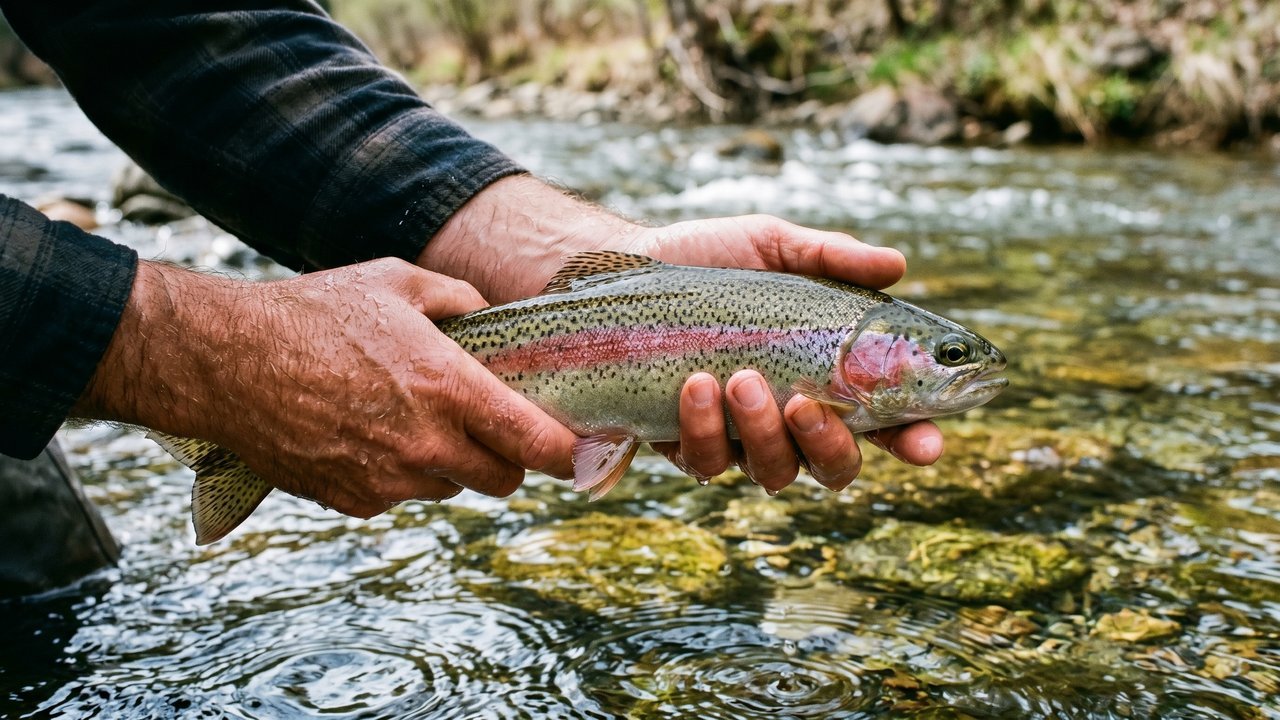
Catch and Release: How to Handle Trout
Trout are fragile fish. Their slime coat, gills, and oxygen needs make them particularly vulnerable to handling stress. If you plan to release a fish, follow these rules.
- Wet your hands before touching: Dry hands strip the protective slime layer that prevents infection.
- Use barbless or crimped-barb hooks: They come out easier and do less damage. Mash the barb flat with pliers in two seconds.
- Keep the fish in the water as much as possible: Even 30 seconds of air exposure can damage gills. If you must lift for a photo, lift, snap, return.
- Support the body, not just the head: Hold the fish horizontally with one hand under the belly and one near the tail. Never squeeze the gills.
- Remove hooks quickly with a hemostat or forceps: If the hook is deep, cut the line near the hook eye rather than ripping it out. Most hooks dissolve in a few weeks.
- Revive before release: Hold the fish upright facing into the current (or gently move it forward and back in still water) until it kicks free under its own power.
Don’t release fish into water warmer than 68 degrees. Thermal stress combined with capture stress kills trout that look fine swimming away. Either keep your legal limit on hot days or wait for a cooler outing.
Frequently Asked Questions About Trout Fishing
What is the best bait for trout?
For stocked rainbow trout, Berkley PowerBait in chartreuse, rainbow, or orange is the most reliable bait, hands down. For wild trout, live nightcrawlers or small inline spinners (Mepps Aglia size 1) catch more fish across more conditions than anything else. Salmon eggs work well for steelhead and big river rainbows in fall and winter.
What size hook should I use for trout?
Use a No. 10 or No. 8 baitholder hook for nightcrawlers and most general trout fishing. For PowerBait specifically, switch to a No. 14 treble hook, which holds the bait better. Smaller hooks (No. 12 or 14) work for very small streams and pressured wild trout. Avoid going larger than No. 6, which spooks fish and doesn’t fit a trout’s small mouth well.
What line weight is best for trout?
4-pound to 6-pound monofilament is the sweet spot for 95% of trout fishing. Use 4-pound for clear water, small streams, and pressured fish. Use 6-pound for larger lakes, heavier cover, and fish over 3 pounds. For trophy water with big browns or steelhead, step up to 8 or 10-pound. For finicky clear-water fish, add a 24 to 36-inch fluorocarbon leader.
What time of day is best for trout fishing?
The first two hours of daylight and the last two hours before dark are the prime trout feeding windows. Water temperatures are at their daily low and insects are most active. Overcast, rainy, or windy days can produce all-day action because fish don’t get pushed deep by bright light. Midday in summer is the toughest time and requires deep water or cold tributaries.
What is the ideal water temperature for trout?
Trout feed most aggressively in water between 50 and 65 degrees Fahrenheit, with 55 degrees being the peak. Above 70 degrees they get stressed; above 75 degrees they may stop feeding and become vulnerable to catch-and-release mortality. Below 45 degrees their metabolism slows and they feed less. A cheap aquarium thermometer on a string is the most underrated tool in a trout angler’s bag.
How do I catch stocked trout vs wild trout differently?
Stocked trout respond to bright, scented baits like PowerBait, fish near the surface, and school tight near release points. Use simple bobber rigs in shallow water close to the stocking site, especially the first few days after a stocking. Wild trout require natural presentations like live worms, small spinners, or flies. Approach them carefully, use fluorocarbon leaders, and target specific lies in streams (pools, riffles, undercut banks).
Can I catch trout without a fly rod?
Yes, absolutely. A light or ultralight spinning rod with 4 to 6-pound monofilament catches every species of trout in nearly every situation. Spinning gear handles bobber rigs, sliding sinker rigs, inline spinners, small spoons, and small crankbaits with ease. Fly fishing has advantages for surface-feeding trout in clear streams, but spin fishing accounts for the vast majority of trout caught in North America every year.
What is the best trout setup for a beginner?
A 6-foot 6-inch light-power spinning combo (Ugly Stik GX2 or similar at around $55), spooled with 4-pound Berkley Trilene XL, a starter pack of No. 10 baitholder hooks, BB-sized split shot, 1-inch clip-on bobbers, and a jar of chartreuse PowerBait. That kit costs under $80 and catches stocked rainbow trout from any pond in America. Once you’ve caught a few fish, add inline spinners, a sliding sinker rig setup, and live worms to expand your skill set.