How to Fish for Bass: A Complete Beginner’s Guide (With Techniques That Actually Work)
To fish for bass, use a medium-heavy spinning rod with 12-15 lb line, target structure like weed edges, docks, and submerged logs, and match your lure to conditions: soft plastics on Texas rigs for cover, spinnerbaits in murky water, and topwater frogs at dawn or dusk. Slow presentations work best in cold water; faster retrieves shine in summer.
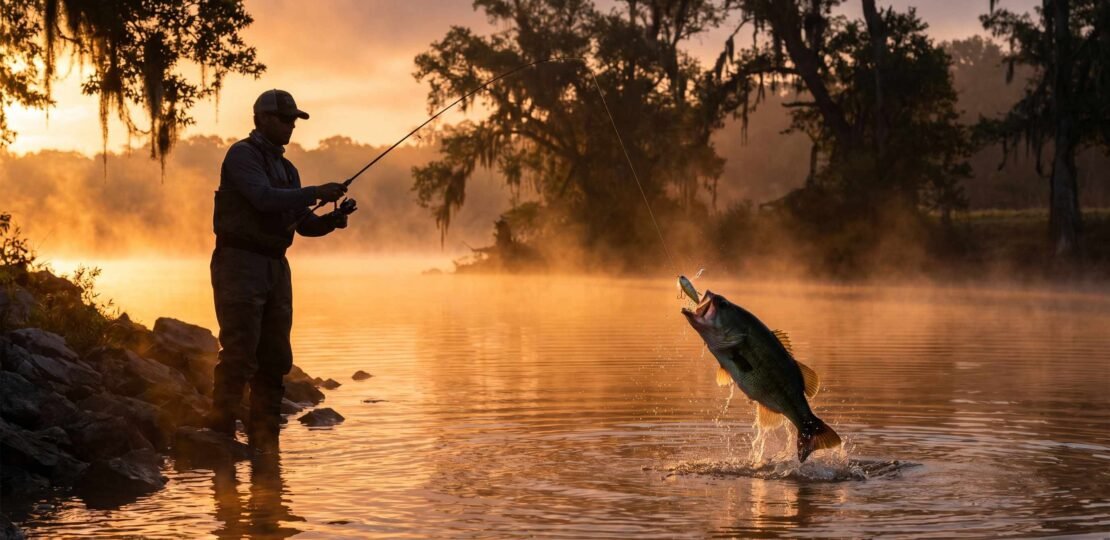
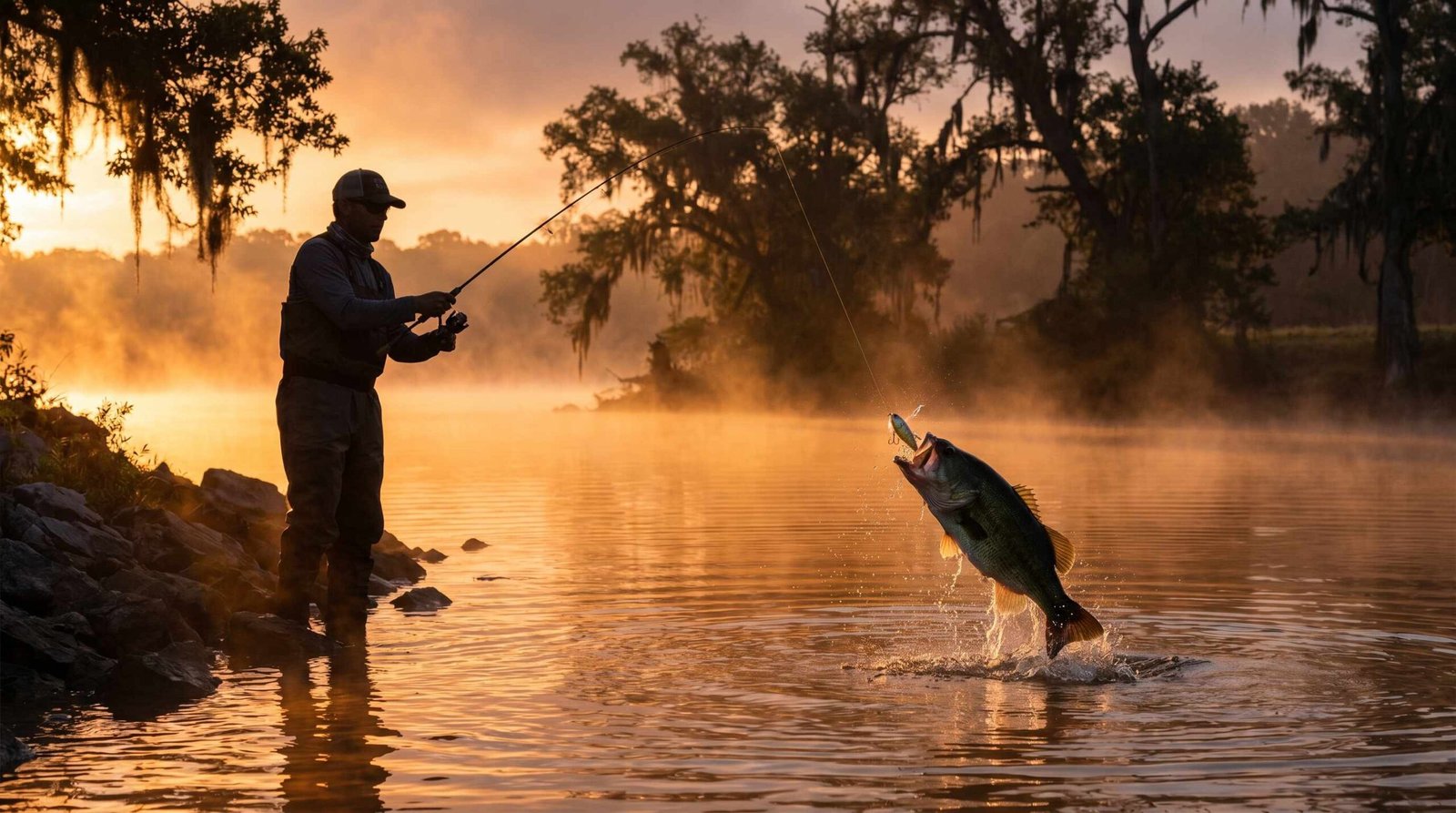
Hook a five-pound largemouth and you understand why bass fishing is an obsession. The strike feels like someone hammered your rod with a brick, the fish goes airborne, and your heart rate doubles in the space of two seconds. That moment, repeatable across ponds, lakes, and rivers in nearly every U.S. state, explains why bass remain the most pursued freshwater game fish in America. Roughly 30 million anglers chase them every year.
What makes bass fishing addictive is that the puzzle never ends. The fish are predictable enough to reward study, yet stubborn enough to humble experts on any given afternoon. A patient beginner with the right approach can outfish a tournament angler who reads the water wrong. This guide walks you through everything you need to start catching bass consistently: the three species, where they hide season by season, the gear that actually matters, the techniques that work, and the mistakes that cost most beginners their first dozen fish. By the time you finish, you will know more than 90% of the casual anglers at your local boat ramp.
Understanding Bass: The Three Species You’ll Encounter
Before you tie on a lure, know your quarry. “Bass” is a casual umbrella term for several closely related fish, but three species cover virtually every bass fishery in North America. They share family traits, they hit lures aggressively, and they live in similar waters. They also differ in ways that change your tactics, so treating them as identical will cost you fish.
Largemouth Bass
The largemouth (Micropterus salmoides) is the species most people picture when they hear the word “bass.” It is the biggest of the three, with mature fish commonly weighing 2 to 6 pounds and trophies pushing into double digits. The world record stands at just over 22 pounds, set in Georgia in 1932. Largemouth thrive in warm, weedy water and tolerate murky conditions that other game fish avoid. They love cover. Lily pads, submerged timber, boat docks, and weed mats are largemouth real estate.
You can identify a largemouth by its upper jaw, which extends past the back of the eye, and by the dark, jagged lateral stripe running down its side. They feed on shad, bluegill, crawfish, frogs, and any unfortunate snake or duckling that wanders too close. Largemouth bass fishing dominates American tournament circuits because the fish are widespread, willing to strike artificial lures, and capable of explosive surface hits.
Smallmouth Bass
Smallmouth bass (Micropterus dolomieu) are a different animal. They prefer clearer, cooler, rockier water, which puts them in northern reservoirs, river systems like the Susquehanna and the upper Mississippi, and the Great Lakes. They run smaller than largemouth on average, with a 3-pound smallmouth considered a solid fish and a 5-pounder a memorable one. Pound for pound, they fight harder than largemouth. A 3-pound smallmouth pulls drag like a fish twice that size.
You can tell a smallmouth by its bronze, brown, or olive coloring with vertical bars on the side, and by the upper jaw that stops at or before the back of the eye. Smallmouth eat crawfish more than any other forage. If you find a rocky bottom in clear water, you are probably looking at smallmouth habitat.
Spotted Bass
The spotted bass (Micropterus punctulatus) is the species most often misidentified as a largemouth. Spotted bass are common in southern reservoirs and river systems from Texas to Tennessee. They average 1 to 3 pounds, with a 5-pounder being noteworthy. The Alabama or Coosa strain of spotted bass grows larger and has produced fish over 10 pounds in California reservoirs where they were introduced.
The giveaway: spotted bass have rows of small dark spots below the lateral line, plus a small tongue patch and a jaw that ends at the back of the eye, like a smallmouth. They behave like a mix of the other two species, holding on structure like smallmouth but tolerating slightly warmer water and weedy cover.
Quick Comparison: Largemouth vs Smallmouth vs Spotted Bass
| Trait | Largemouth | Smallmouth | Spotted |
|---|---|---|---|
| Average size | 2-6 lbs | 1-3 lbs | 1-3 lbs |
| Preferred habitat | Warm, weedy, shallow | Clear, cool, rocky | Clear, rocky reservoirs |
| Water temp preference | 65-85°F | 55-75°F | 60-80°F |
| Favorite forage | Shad, bluegill, frogs | Crawfish, minnows | Shad, crawfish |
| Go-to lures | Texas rigs, frogs, jigs | Tubes, drop shot, Ned rig | Drop shot, jerkbaits, shaky head |
| Jaw line marker | Past the eye | Stops at eye | Stops at eye |
Bass Behavior Through the Seasons
Bass move. Their location changes month to month based on water temperature, spawning urge, and food availability. If you fish the same shoreline year-round with the same lure, you will catch bass occasionally, but you will miss the fish 75% of the time. Learning the seasonal pattern is the single biggest skill jump in bass fishing.
Spring: Pre-Spawn, Spawn, and Post-Spawn
Spring is the best season to fish for bass, full stop. Water temperatures climb from the low 50s into the 70s, and bass move from deep winter haunts into shallow water in three distinct waves.
Pre-spawn begins when water hits roughly 50°F. Bass stage on the first major drops near spawning flats, often holding 8 to 15 feet down on points, ledges, and creek channel bends. They are feeding aggressively to build fat reserves. Lipless crankbaits, jerkbaits, and slow-rolled spinnerbaits dominate this period. Fish are concentrated and hungry.
Spawn hits when water reaches 60 to 65°F. Bass move into 1 to 6 feet of water and build beds on hard bottom areas: gravel, sand, and root mats. You can often see the saucer-shaped beds in clear water. Sight-fishing the spawn is controversial in some circles, but it is legal in most states. Soft plastic creature baits and lizards on a Texas rig drive bedded bass crazy. Many anglers release every spawning fish to protect the next generation.
Post-spawn hits 65 to 72°F. The females recover, the males guard fry, and feeding picks back up. Topwater action heats up. Walking baits, poppers, and buzzbaits all produce. Bass move to the first cover off the spawning flats, often weed edges and laydown trees in 4 to 8 feet of water.
Summer: Deep, Then Shallow
Summer bass live two lives. During the day, especially in lakes deeper than 20 feet, bass slide out to main-lake structure: humps, points, channel edges, and brush piles in 15 to 30 feet of water. The thermocline forms in many lakes around 18 to 22 feet, and bass hold just above it where oxygen and cool water meet baitfish.
At dawn and dusk, the same fish push shallow to feed. Topwater fishing in the first hour of light is one of the great experiences in freshwater angling. A buzzbait or Whopper Plopper worked along a grass line at sunrise can produce vicious strikes. After mid-morning, switch to deeper presentations: deep-diving crankbaits, football jigs, big worms on Carolina rigs, or a drop shot dropped onto isolated structure.
In ponds and shallow lakes where bass cannot escape into deep water, summer fish hold tight to shade. Dock pilings, overhanging trees, and matted vegetation are gold. Flipping a Texas-rigged creature bait into the shade pockets at noon produces fish that look impossible.
Fall: The Feeding Frenzy
Fall is the second-best season for bass fishing and arguably the most overlooked. As water cools from the mid-70s down through the 60s, bass go on a feeding binge to build winter fat. They follow shad migrations into creeks and the back ends of coves. Find the bait, find the bass. It is that simple.
Use moving baits that cover water: lipless crankbaits, square-bill crankbaits, spinnerbaits, swim jigs, and small swimbaits. Bass are not picky in fall. They are aggressive and ready to chase. If a school of bass is busting shad on the surface, throw anything white or silver, work it fast, and hang on.
Winter: Slow, Deep, Patient
Winter bass fishing is the toughest season, but it is also when the biggest fish of the year come out. As water drops below 50°F, bass slow their metabolism and bunch up in the deepest, most stable parts of the lake. They feed in short windows on warm afternoons.
Slow down everything. A jig dragged painfully slow on the bottom, a blade bait jigged vertically, a hair jig pitched to a sunken bush, or a jerkbait paused for 8 to 10 seconds between twitches. Cold water bass will not chase, so the lure has to sit in their face. Pick warm afternoons after a few stable days, and target the deepest structure in the area.
How to Read the Water: Where Bass Hide
If you can read water, you can catch bass anywhere. Most beginners cast at random and hope. Experienced anglers look at a lake and instantly identify the 5% of water that holds 95% of the fish. Learning this skill is the difference between a frustrating day and a fish every cast.
Structure vs Cover: They Are Not the Same
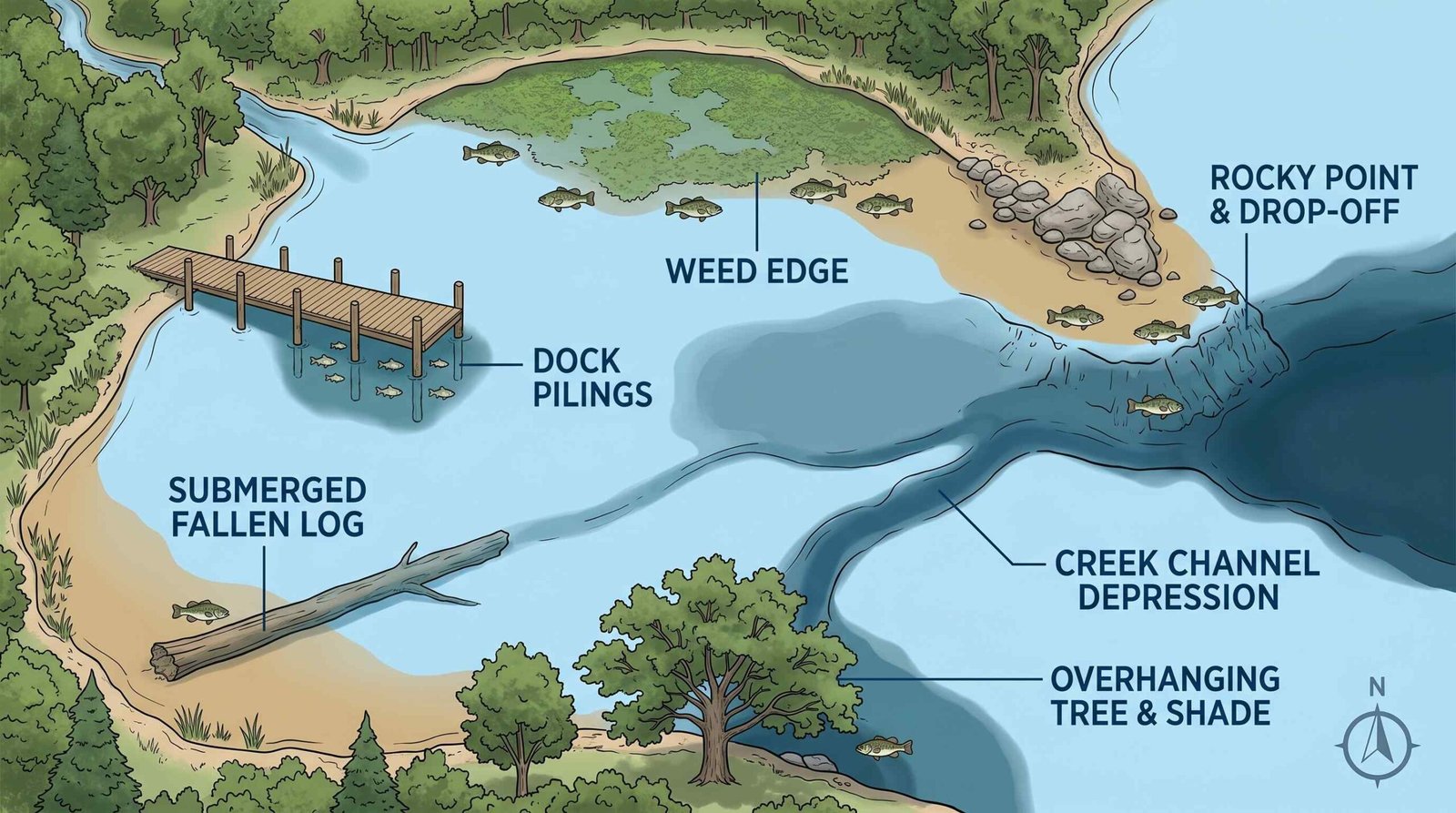
This distinction trips up beginners, and getting it right unlocks better water reading. Structure is the shape of the bottom: points, humps, ledges, creek channels, depth changes. Cover is anything bass hide in or around: weeds, logs, docks, rocks, brush piles. The best spots have both. A rocky point (structure) with a fallen tree on it (cover) is a bass magnet. A flat featureless bank with no cover is usually dead water.
Key Bass Locations
- Weed edges and grass lines. The outside edge where a weed bed meets open water is one of the most productive zones in any lake. Bass cruise these edges like wolves patrolling a fence line. Parallel a weed edge with a spinnerbait or swim jig and you will find fish.
- Submerged logs and fallen trees. Locally called laydowns, these holds bass at almost every depth. Cast past the log, retrieve along its length, and pay attention to the deeper end where the trunk meets the bank. Big fish often sit on the deep root ball.
- Dock pilings and boat docks. Docks provide shade, structure, and ambush points all in one package. Skip a wacky-rigged Senko underneath a dock with low overhead clearance and you will catch the fish nobody else can reach.
- Rocky points and transitions. Points that extend from the shoreline into deeper water funnel baitfish and concentrate predators. Transitions where rock meets sand, or gravel meets mud, are especially productive. Smallmouth love these.
- Creek channels and depth changes. Bass use creek channels as highways. In larger lakes, find the old river bed and the feeder creek channels that branch off it. Bass stack on the bends and intersections.
- Overhanging trees and shade. Tree limbs that hang over the water create cool, shaded ambush zones. In summer, these spots can hold multiple fish. A skip cast with a soft plastic into the deepest shade pocket draws strikes that come out of nowhere.
- Isolated cover. A single stump or rock in an otherwise featureless flat is a magnet. Bass concentrate on whatever stands out. The more isolated, the better.
Essential Bass Fishing Gear for Beginners
You can spend $5,000 on bass tackle, but you do not need to. A new angler can put together a solid, capable setup for under $200 that will catch fish in any water from Florida to Minnesota. The goal is to buy gear that matches what you actually do, not the gear that pros use on national TV.
Choosing the Right Rod
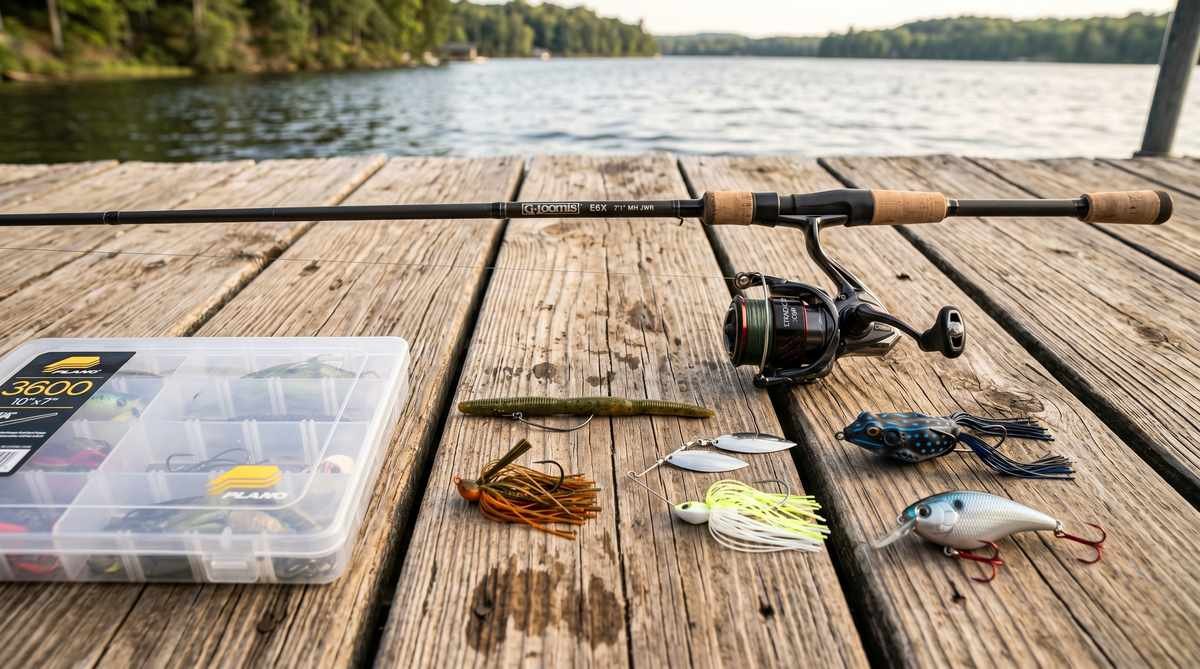
For a single all-purpose bass rod, go with a 7-foot, medium-heavy power, fast-action spinning rod. That single sentence summarizes 90% of beginner needs. Here is why each part matters:
- Length: 7 feet gives you long casts and decent leverage on fish, without becoming unwieldy in tight cover. Shorter rods (6 to 6’6″) are better in small ponds with overhanging trees.
- Power: Medium-heavy handles everything from quarter-ounce finesse lures to half-ounce jigs and Texas rigs. A pure medium is too light for heavy cover; a heavy rod is overkill for finesse.
- Action: Fast action bends in the top third of the rod, giving you the sensitivity to feel bites and the backbone to drive hook sets.
Brands like St. Croix, Dobyns, and Daiwa make excellent rods in the $80 to $150 range. Ugly Stik and Shakespeare offer solid budget options under $50 that will not let you down on small ponds.
Spinning vs Baitcasting Reels
Start with a spinning reel. Spinning reels are forgiving, easy to cast light lures, and almost impossible to backlash. A 3000-size reel matched to a medium-heavy rod is the standard. For a budget-friendly entry point, look at the budget-friendly spinning reel guide on our site for specific models that hold up under hard use.
Baitcasting reels offer more accuracy and power for heavy lures, but they have a steep learning curve. Most experienced bass anglers own multiple baitcasters because of the casting precision they provide with heavy presentations. Save the baitcaster for season two, after you can confidently catch fish on spinning gear.
Fishing Line
Line choice matters more than most beginners realize. Three options dominate bass fishing:
- Monofilament (10 to 17 lb): Cheap, stretchy, floats. Great for topwater lures and beginners learning to feel bites. Mono has more give, which is forgiving on hook sets but masks subtle strikes.
- Fluorocarbon (10 to 20 lb): Nearly invisible underwater, sinks, low stretch. The default for clear-water finesse fishing, Texas rigs, jigs, and crankbaits. More expensive but worth it for finicky fish.
- Braided line (30 to 50 lb): Zero stretch, super strong, thin diameter. Use it for frog fishing, flipping into thick cover, and topwater. Tie on a 12 to 15-lb fluorocarbon leader if the water is clear.
For one all-purpose spool, start with 12-lb fluorocarbon. It handles most situations adequately and teaches you to feel a bite.
Must-Have Bass Lures
You do not need a tackle box the size of a refrigerator. Start with these eight lures and you can catch bass in any conditions:
- Soft plastic stickbaits like the Yamamoto Senko in 5 inches, watermelon or green pumpkin. The most versatile bass lure ever made.
- Soft plastic creature baits for Texas rigs and flipping. Strike King Rage Bug or Zoom Brush Hog.
- Curly tail worms in 6 to 7 inches, junebug or watermelon red, for Texas rigging.
- 3/8-ounce spinnerbait in white or chartreuse-white for covering water.
- 1/2-ounce skirted jig in black-blue or green pumpkin with a craw trailer.
- Topwater frog like a SPRO Bronzeye for fishing matted vegetation.
- Walking topwater like a Heddon Zara Spook or Rebel Pop-R for open-water surface action.
- Square-bill crankbait in shad or crawfish patterns, diving 3 to 6 feet, for shallow cover.
That kit, combined with the right rod, reel, and line, will handle 95% of the bass fishing situations you will encounter in your first few years.
Top Bass Fishing Techniques (Comparison Table)
Technique is what separates anglers who catch the occasional bass from anglers who catch them consistently. The good news: you do not have to master every technique. You need to know which one matches the conditions in front of you, and how to execute it well. Most B.A.S.S. tournament professionals rely on a small handful of techniques they have refined over thousands of hours on the water.
| Technique | Best Season | Best Conditions | Skill Level | Best Cover Type |
|---|---|---|---|---|
| Texas Rig | All seasons | Any water clarity | Beginner | Heavy cover, weeds, wood |
| Ned Rig | Spring through fall | Clear, slow water | Beginner | Rocky bottoms, sparse cover |
| Drop Shot | Summer, winter | Clear, deep water | Intermediate | Open water, suspended fish |
| Spinnerbait | Spring, fall | Murky water, wind | Beginner | Weed edges, laydowns |
| Topwater Frog | Summer | Calm, warm, low light | Intermediate | Matted vegetation, lily pads |
| Crankbait | Spring, fall | Any clarity, wind helpful | Beginner | Open water, rocky points |
| Jig | All seasons | Cool to warm water | Intermediate | Wood, rocks, deep cover |
| Carolina Rig | Summer | Hot, deep, slow bite | Intermediate | Main lake points, humps |
Texas Rigged Soft Plastics
If you only learn one technique, learn this one. The Texas rig is the most versatile bass presentation ever developed. You slide a bullet weight onto your line, tie on a 3/0 or 4/0 worm hook (offset shank), and rig a soft plastic worm or creature bait weedless on the hook. The point of the hook is buried in the plastic, letting you cast into thick cover without snagging.
The basic retrieve is a slow lift-and-drop. Cast to cover, let it sink, lift the rod tip slowly, then drop the rod to let the bait fall on slack line. Most strikes happen on the fall, so watch your line. If it twitches, jumps, or moves sideways, set the hook hard.
Adjust the weight to the situation: 1/8 ounce for shallow water and slow fall, 1/4 ounce for general fishing, 3/8 to 1/2 ounce for flipping heavy cover. Pegging the weight against the bait with a bobber stopper is essential when fishing thick grass.
The Ned Rig
The Ned rig has converted skeptics into believers in the last decade. It is a finesse technique: a small 2.5 to 3-inch stickworm threaded on a small mushroom jig head, usually 1/10 to 1/6 ounce. The bait stands up on the bottom and quivers seductively when twitched.
Cast it out, let it hit bottom, then deadstick it. Twitch the rod tip every 10 to 15 seconds. The Ned rig catches fish when nothing else will. Clear-water smallmouth eat it with abandon, and pressured largemouth in heavily fished lakes will hit it when they refuse everything else. The setup is forgiving and the strikes are obvious.
Drop Shot
The drop shot is a vertical or near-vertical presentation built for deeper water and suspended fish. You tie a hook 12 to 18 inches above a small weight (1/4 to 3/8 ounce). The hook stays off the bottom while the weight drags. You nose-hook a 3 to 5-inch finesse worm or minnow plastic and shake the rod tip in place.
Drop shotting shines on offshore structure, around bridge pilings, and when bass are suspended over deep water. Modern forward-facing sonar has made this technique even deadlier, but you can drop shot effectively with basic sonar or by knowing where to look. Smallmouth on rocky lake bottoms in 15 to 25 feet of water are particularly susceptible.
Spinnerbaits
Spinnerbaits cover water and trigger reaction strikes. The flashing blades imitate baitfish, and the safety-pin design makes them surprisingly weedless. They work best in stained or muddy water and in low light conditions. Wind helps. Calm sunny days with clear water are spinnerbait death.
Standard retrieves: slow roll along the bottom in cold water, steady medium retrieve at mid-depth, or burn it just below the surface in warm weather. Bump it into cover, then let it drop. Strikes often come immediately after a deflection.
For blade selection, double willow blades work in clear water for maximum flash and minimum vibration. Colorado and Indiana blades push more water, which makes them better in muddy water where fish hunt by feel.
Topwater Lures: Poppers and Frogs
Nothing in bass fishing matches a topwater strike. Watching a 4-pound largemouth crash a popper at first light is why people get hooked on this sport.
Topwater shines in warm water (above 65°F), early and late in the day, and on overcast days. Three main categories of topwater:
- Walking baits like the Zara Spook. Use a rhythmic twitch, twitch, pause cadence. The bait walks left-right across the surface in a zigzag.
- Poppers like the Rebel Pop-R. Sharp downward rod pulls create chugs and splashes. Vary the cadence until fish respond.
- Hollow-body frogs like the SPRO Bronzeye. Skip and walk them across matted vegetation. Bass blow up through the mat to eat them.
Topwater discipline: when a bass blows up on your lure, do not set the hook immediately. Wait until you feel the weight. Setting on the splash pulls the lure out of the fish’s mouth. This is the single hardest habit for beginners to learn.
Crankbaits and Swimbaits
Crankbaits dive to specific depths based on lip size and shape. The whole point of cranking is contact: you want the lure to hit cover and deflect. Bass strike the irregular movement after the deflection, not the steady wobble.
Square-bill crankbaits dive 3 to 6 feet and work along shallow cover like laydowns and stump fields. Medium-diving crankbaits like the Rapala DT-10 work points and ledges. Deep divers like the Strike King 6XD reach 15 feet or more for summer offshore work.
Swimbaits, both soft and hard, imitate baitfish more realistically. A 5-inch paddle-tail swimbait on a swimbait jig head is one of the simplest and most effective ways to catch bass in nearly any water. Cast it out and reel it back at a steady moderate pace.
Fishing Different Water Types
Bass live almost everywhere fresh water exists in the continental U.S. The same fish behaves differently based on where it lives. A largemouth in a 5-acre farm pond is not playing the same game as a largemouth in a 30,000-acre reservoir. Adapt your approach to the water type and your catch rates climb.
Ponds and Small Lakes
Ponds are the most accessible bass fisheries in America. Every neighborhood seems to have a pond, golf course, or small lake somewhere. Pond bass behave predictably because they have fewer options. Cover is limited, so bass concentrate on what is available. A single fallen tree, a culvert pipe, or a patch of cattails can hold most of the fish in a small water.
Work cover thoroughly in ponds. Make multiple casts at every piece of structure from different angles. Pond bass often see the same lures repeatedly, so finesse presentations like a wacky-rigged Senko or a Ned rig outproduce louder offerings. Walk the entire shoreline once you have probed the obvious spots; you will be amazed what hides in plain sight.
Large Lakes and Reservoirs
Large bodies of water look intimidating, but they obey the same rules. Bass relate to structure. The trick is knowing what structure to target on a given day. On lakes over 5,000 acres, focus on creek channels, main-lake points, humps, and bridge crossings. Spend the first 30 minutes on a new lake studying a contour map or your fish finder before you make a single cast.
Wind matters a lot on big water. The windblown bank concentrates plankton, which concentrates baitfish, which concentrates bass. When in doubt, fish into the wind. Yes, it is harder to cast. Yes, it is uncomfortable. The fish will be there.
Rivers and Streams
River bass, particularly smallmouth, are wild fighters. The current shapes everything about how they live and feed. They sit in current breaks behind rocks, in eddies below bends, and on shallow flats at the edge of moving water. Cast upstream and retrieve down with the current. Anything moving naturally with the flow looks like food.
River bass typically run smaller than lake bass but make up for it in aggression. The Susquehanna, the Mississippi, the Ohio, and dozens of smaller rivers offer outstanding smallmouth fishing from May through October. If you fish a river system that also holds catfish, walleye, or pike, consider it a multi-species opportunity; some research into the best catfish bait options can turn a slow afternoon into a productive evening for a different species.
Key river tactics: tubes and small jigs for smallmouth on the bottom, jerkbaits in slack water, and topwater poppers on shallow flats early and late.
Timing: When to Fish for Bass
You can have the right gear and the right technique, but if you fish at the wrong time, you will struggle. Bass have feeding windows. Hitting those windows can mean the difference between a 2-fish day and a 20-fish day.
Best Times of Day
The dawn-and-dusk rule is widely repeated and largely correct. Bass feed most actively in low light. The first hour after sunrise and the last hour before sunset are prime windows. The exception: when water temperatures climb into the 80s in summer, midday can shut down completely, while a night bite kicks in around boat docks and lights.
In spring and fall, the bite often extends throughout the day. On overcast days with stable weather, bass can feed all day long. Sunny bluebird days after a cold front are the toughest scenario, often forcing you to slow down and finesse fish.
Water Temperature Sweet Spot
Bass have a comfort zone, and they fight harder, eat more, and stay shallower within it. Largemouth bass are most active between 65°F and 80°F. The peak feeding window is 68 to 75°F, where metabolism, oxygen levels, and forage availability align. Smallmouth prefer slightly cooler water, peaking around 60 to 72°F.
A cheap floating thermometer or the temperature gauge on a basic fish finder is one of the most underused tools in bass fishing. Knowing the water temperature tells you which season you are functionally in, regardless of the date on the calendar. Research from university extension programs on largemouth bass biology, and data compiled by state cooperative fisheries agencies across the country, consistently shows that bass feeding activity drops sharply below 50°F and above 85°F.
Weather Patterns
Weather drives bass behavior more than most factors. Some rules to live by:
- Overcast skies: Bass feel safe in low light and roam more. Expect a stronger bite all day.
- Light rain: Outstanding. Rain dimples the surface, hides your presence, and triggers feeding.
- Approaching front: The day before a storm is often the best fishing of the week.
- Bluebird skies after a cold front: The toughest scenario. Slow down, fish deeper, and finesse it.
- Wind: Light to moderate wind helps. It creates current, breaks up surface clarity, and scatters baitfish.
- Heavy rain or heavy mud after a storm: Fishable but tough. Move to clearer water if you can find it.
Moon Phases
Moon phase effects on bass behavior are debated. Some anglers swear by full and new moon periods, particularly during the spawn. The reality: moon phase matters less than weather, temperature, and pressure. Do not skip a good fishing day because the moon phase is wrong. Do not expect magic on a bad weather day just because the moon is full. Treat it as a minor factor at most.
Common Mistakes Bass Anglers Make
Beginners (and plenty of intermediates) sabotage their own fishing in predictable ways. Avoid these six errors and you will catch more bass immediately, no new gear required.
- Fishing too fast. The single most common mistake. Most beginners burn their lure across the bottom or surface, expecting bass to chase. Most bass will not. Slow down. Pause more. Let the lure sit. The fish are watching it.
- Using line that is too heavy. Twenty-pound line on a finesse setup spooks bass in clear water. Match the line weight to the lure and the conditions, not to the biggest fish you hope to catch. Twelve-pound fluorocarbon handles 99% of bass.
- Ignoring the weather and temperature. Showing up to fish topwater in 45°F water is wasted effort. Check the water temperature, look at recent weather patterns, and adjust your approach.
- Not working cover thoroughly. Beginners cast once at a piece of cover and move on. Pros make 10 casts from different angles. Bass position on cover based on subtle factors you cannot see. Multiple presentations from multiple angles draws strikes.
- Poor hook sets. A bass has a hard, bony mouth. Set the hook hard, like you mean it. Reel up slack, drop the rod tip, then sweep the rod up sharply. A weak hook set loses fish before you ever feel weight.
- Making too much noise. Stomping in a boat, slamming hatches, dropping pliers, or running an outboard motor over shallow fish all spook bass. Shallow fish in clear water are particularly skittish. Move slowly, keep noise down, and stand back from the bank when shore fishing.
Bass Fishing FAQ
What is the best bait for bass?
The single most productive bass bait is a 5-inch soft plastic stickbait like a Yamamoto Senko, rigged wacky style (hooked in the middle) or weightless Texas style. Bass eat it in nearly every condition. For live bait, golden shiners and large minnows are deadly. If you can use only one artificial lure for the rest of your life, make it a green pumpkin or watermelon Senko.
How deep do bass go in summer?
In summer, bass can hold anywhere from the surface (early and late in the day) to 30 feet or deeper during midday in clear lakes. The most common summer depth range is 12 to 25 feet, where bass position just above the thermocline. In shallow lakes and ponds, bass cannot escape into deep water and instead hold in shade under cover.
What size hook for bass fishing?
For most soft plastic worm rigging, use a 3/0 or 4/0 offset worm hook. For larger creature baits, step up to a 5/0. For finesse presentations like a wacky rig or drop shot, use a size 1 or 1/0 octopus or finesse hook. Topwater frogs require a heavy 4/0 or 5/0 double frog hook. The general rule: bigger hook for bigger plastic and heavier cover.
Do bass bite in the rain?
Yes. Light rain is one of the best conditions for bass fishing. Rain dimples the surface, reduces light penetration, makes bass feel safer, and often triggers a feeding response. Heavy thunderstorms can be productive just before they hit, then shut fishing down during the worst weather. Avoid lightning at all costs. As soon as you hear thunder, get off the water.
What time of year is bass fishing best?
Spring is universally considered the best season for bass fishing, particularly the pre-spawn and post-spawn periods when bass are actively feeding in shallow water. Water temperatures of 55 to 70°F create the most active bite. Fall is the second-best season, with bass feeding hard before winter. Trophy fish are most common in March and April in most regions.
Can you catch bass from shore?
Absolutely. Bank fishing for bass is hugely popular and effective. Focus on accessible features like dock pilings, fallen trees along the shoreline, drainage culverts, and the points where coves meet the main lake. Many of the biggest bass each year are caught from shore. The key is approaching the water quietly and casting parallel to the bank rather than straight out into deep water.
What is the best rod length for bass fishing?
The best all-purpose bass rod is 7 feet long, medium-heavy power, with fast action. This length covers nearly every technique with reasonable effectiveness. Shorter rods (6 to 6’6″) work better in small ponds with overhanging trees or for casting under docks. Longer rods (7’6″ to 8′) excel at specific techniques like flipping heavy cover or long-distance crankbaiting from a boat.
How do you tell largemouth from smallmouth bass apart?
The easiest tell is the upper jaw. On a largemouth, the upper jaw extends past the back of the eye. On a smallmouth, the upper jaw ends at or before the back of the eye. Color also helps: largemouth are typically green with a dark horizontal lateral stripe, while smallmouth are bronze or brown with vertical bars on the sides. Smallmouth prefer cooler, clearer, rockier water; largemouth prefer warmer, weedier water.
Putting It All Together
Bass fishing rewards persistent learners. The fish are predictable enough that knowledge compounds, season after season. Read the water, match your technique to the conditions, and pay attention to what works on each trip. Keep a small notebook or use a phone note to log water temperature, weather, lures, and locations every time you fish. Within a year, you will have your own pattern book for your local waters that no guide could give you.
Start simple. Pick one lake or pond. Get one good rod, reel, and a small selection of lures. Fish it in different conditions throughout the year. Pay attention to where you caught fish and where you did not. Bass fishing is not about exotic gear or secret lures. It is about water reading, timing, and a few well-practiced techniques.
The biggest bass of your life is swimming in water you can probably reach this weekend. Now you have the framework to catch it. For deeper species information, the U.S. Fish & Wildlife Service maintains habitat and conservation data on all three bass species across their native and introduced ranges. Pair that background knowledge with the practical tactics above, and your fishing log will fill up faster than you expected.
Go fish.