Best Walleye Lures in 2026: A Season-by-Season Selection Guide
Walleye fishing rewards anglers who match their lure to the conditions in front of them, not the ones they wish they had. This guide cuts through the noise by giving you a decision framework: which lure for which season, water clarity, and depth, so you know exactly what to tie on right now.
What is the best lure for walleye?
The best walleye lure is a 1/4 oz jig like the VMC Neon Moon Eye paired with a soft plastic or live minnow, because it works across seasons, depths, and water clarities. For active summer fish, switch to crankbaits like the Bandit Walleye Deep for trolling, or crawler harnesses for suspended fish in deeper basins. Match color to clarity: natural in clear water, chartreuse in stained.
Why Lure Selection Matters More for Walleye
Walleye have a built-in advantage that most freshwater species lack: a reflective layer behind their retinas called the tapetum lucidum. This is the same eye-shine you see in a deer at night. It gives walleye dramatically better low-light vision than baitfish, which is why they feed hardest at dawn, dusk, and after dark. You can read the full breakdown of walleye biology and behavior in our complete walleye fishing guide.
That vision advantage also means walleye are pickier about color and size than bass or pike. They get a better look at your offering, especially in clear water. Pick the wrong shade in a finicky bite and you go home empty. Pick the right one and a slow day turns fast. Walleye also have a documented sensitivity to color along a yellow-orange-green axis, while blues and purples register as muted gray tones. This is why chartreuse and orange dominate walleye color palettes, while bass lures lean more heavily on blue, purple, and watermelon shades.
Beyond color, walleye respond to vibration and sound differently than other gamefish. Their lateral line is well-developed but their strike triggers tilt toward subtle, dying-baitfish presentations rather than aggressive chases. A walleye will follow a fast crankbait for 20 feet and then refuse it because the speed feels wrong. A jig that falls one second too fast can be ignored. Slowing down and matching conditions is half the battle.
Quick Comparison: 10 Best Walleye Lures at a Glance
| Lure | Best For | Conditions | Season | Approximate Price |
|---|---|---|---|---|
| VMC Neon Moon Eye Jig | Most versatile, all-around | Any clarity, 5-25 ft | Year-round | $2-$4 per jig |
| Rapala Original Floater | Clear water, shallow casting | Clear, 2-8 ft | Spring | $8-$10 |
| Berkley Gulp! Minnow Grub | Jig trailer, beginner-friendly | Any clarity | Year-round | $6-$8 per pack |
| Northland Thumper Jig | Heavy cover, current breaks | Stained, river | Spring, fall | $3-$5 per jig |
| Rapala Rippin’ Rap | Cold water, vertical jigging | Stained to clear, 8-25 ft | Late fall, winter | $10-$13 |
| Bandit Walleye Deep Crankbait | Summer trolling | Any clarity, 12-25 ft | Summer | $7-$9 |
| Z-Man Jerk ShadZ | Soft jerkbait, slow presentation | Clear to lightly stained | Spring, fall | $5-$7 per pack |
| Northland Buck-Shot Rattle Spoon | Jigging spoon, ice and open water | Any clarity, vertical | Winter, fall | $5-$7 |
| Berkley PowerBait Minnow | Finesse, cold front situations | Clear, neutral fish | Year-round | $5-$7 per pack |
| Northland Crawler Harness | Summer trolling, suspended fish | Clear to stained, 10-30 ft | Summer | $3-$5 |
This table sits at the top intentionally. If you only have time to grab a handful of lures before tomorrow’s trip, build your box around these 10. Each one has earned its place through decades of tournament results, guide use, and grassroots angler reports across the walleye belt. The price ranges reflect 2026 retail; you can usually save 10 to 20 percent buying in three-packs or during off-season clearance.
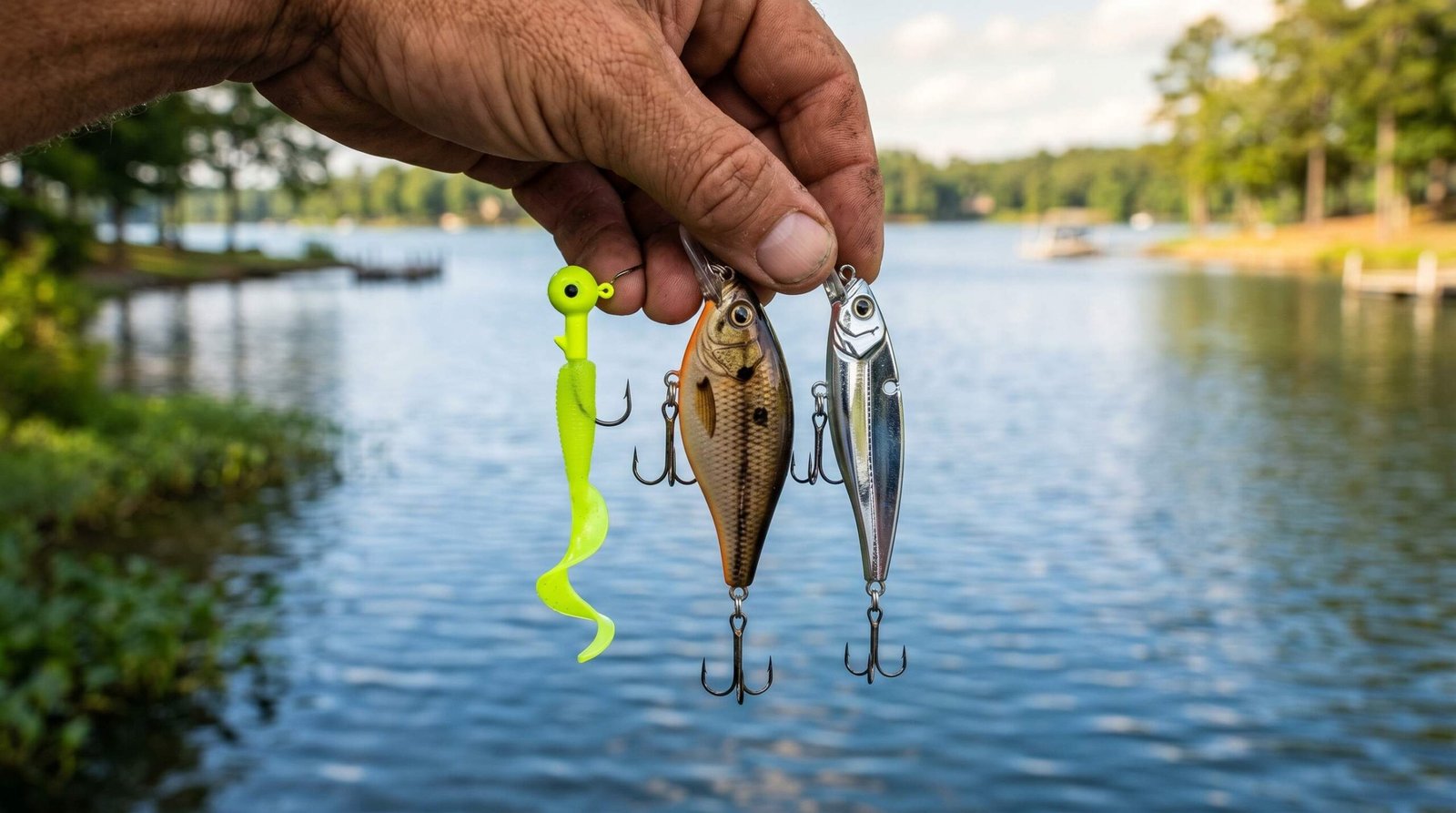
Walleye Jigs: The Most Versatile Walleye Lure
If you only buy one walleye lure category, buy jigs. Nothing else covers as much water, depth, and seasonal range. A well-presented jig catches walleye in March under ice, in May on rocky shorelines, in July at 22 feet, and in October on wind-blown points. We suggest stocking jigs before anything else. Ask any veteran walleye guide what they tie on first, and the answer is universal: a jig with a minnow or soft plastic. Tournament walleye anglers carry hundreds of jig variations, but the working principles boil down to four variables: head shape, weight, hook size, and color.
Ball Jigs vs Specialty Jigs
The standard round-head ball jig in 1/4 oz handles 80 percent of walleye situations. It falls clean, slides through rocks, and pairs with any soft plastic or live bait. The round head is hydrodynamically neutral, meaning it falls straight down and does not plane or glide on the descent. That predictability is exactly what you want when you are trying to read subtle takes on the drop.
Specialty jigs earn their keep in specific scenarios. The Northland Fireball Jig has a short shank and oversized hook designed for tipping a whole minnow without burying the point in its body. This matters more than most anglers realize, because the short-shank design improves your hook-up ratio on light, hesitant takes. The Northland Thumper Jig adds a willow blade that flashes and vibrates, perfect for stained river water or murky reservoir flats where walleye hunt by sound and vibration as much as by sight. The football head, popular among bass anglers, also has a place in walleye fishing on rocky bottoms because it stands the hook up and reduces snags.
Stand-up jigs (sometimes called bobber-style or pony-head jigs) work well when you want the bait to sit upright on bottom during long pauses. These shine during cold-front situations where walleye refuse to chase and prefer a bait that just sits there twitching. Aspirin-head and erie-rig jigs are flat, sliding designs used for drift fishing with live bait in current. Each head shape has a niche, but if you are starting out, stock round-head ball jigs in three weights and call it a day.
Jig Weight by Depth: The Simple Rule
Walleye anglers overcomplicate jig weight. Here is the simple version we use across hundreds of trips:
- 1/8 oz for 0 to 10 feet of water, light wind, finicky fish
- 1/4 oz for 10 to 20 feet, average conditions, the workhorse weight
- 3/8 to 1/2 oz for 20-plus feet, heavy current, or strong wind drift
If you cannot feel bottom on a slow drag, you are too light. If your jig plows the bottom and snags constantly, you are too heavy. The right weight ticks structure but lifts cleanly with a small rod tip flick. Wind multiplies effective weight; on a windy day in 12 feet of water, you may need 3/8 oz to keep contact even though a 1/4 oz would do the job in calm conditions. Current works the same way. A river jig in moderate flow at 8 feet often calls for 1/4 oz, while the same depth in still water would only need 1/8 oz.
One trick we have learned over the years: when in doubt between two weights, go lighter. A walleye is more likely to eat a slow-falling 1/4 oz jig than a fast-falling 3/8 oz, even at depth. Use the lightest weight that still gives you bottom feel. This is especially true in cold water, where a slow fall triggers more strikes than a fast vertical drop.
Soft Plastic Trailers and Live Bait
A naked jig catches walleye. A jig with the right trailer catches more. The three trailers we always carry: a 3-inch curl-tail grub for warm water and active fish, a 3.5 to 4-inch paddle tail (like the Z-Man Trick ShotZ) for thumping vibration in stained water, and a pack of Berkley Gulp! Minnows for cold water and neutral fish. Gulp soaks the jig in scent and is the closest thing to live bait without keeping a minnow bucket alive.
Live bait still has its place, especially in spring and cold water. A lively shiner on a Fireball jig outproduces almost any artificial during the post-spawn period. Leeches dominate in early summer for many Upper Midwest lakes. Crawlers (nightcrawlers) work year-round when threaded on a 1/8 oz jig and drifted slowly along bottom. Many walleye anglers run a hybrid program: jig and live bait for high-percentage moments, artificial soft plastics for covering water.
For soft plastic colors, we lean on three combinations that work everywhere: white-with-chartreuse-tail, motor oil pumpkin, and bubble gum (a pink-and-white blend). These three covers clear, stained, and muddy water respectively. Brand matters less than presentation: a budget Bass Pro paddle tail in the right color outfishes a premium soft plastic in the wrong color every time.
Best Jigging Technique for Walleye
The classic mistake is rushing the fall. Walleye eat jigs on the drop more than the lift. After a hop, let the jig pendulum back to bottom on a tight line. Watch your line where it enters the water. If it twitches, jumps, or stops short, set the hook. Three techniques cover most situations:
- Slow drag: drift or troll at 0.4 to 0.8 mph, keeping the jig ticking bottom. Best for cold water and inactive fish. Use the trolling motor on lowest speed or let the wind push you across a flat. Maintain just enough tension to feel the jig ticking the bottom on every revolution of your reel handle.
- Short hops: 6 to 12-inch lifts, pause on the fall. The all-purpose retrieve. Work this off the bow or the stern; cast slightly upcurrent or up-drift and let the bait swing past you. Strikes happen on the fall 80 percent of the time, so keep the line tight without lifting the jig off bottom prematurely.
- Vertical jigging: straight under the boat over a marked school, snap-pause with a tight line. This is the technique that wins tournaments. Use sonar to mark fish, hold over them, and work the jig at the exact depth of the marks. A small twitch of the rod tip is enough. Big sweeps actually move the jig out of the strike zone.
One under-talked technique: the snap-snap-drop. Two short rod tip pops to jump the jig 8 to 12 inches off bottom, then a controlled fall on a slightly slack line, then a long pause on the bottom. Repeat. This mimics a wounded baitfish trying to escape and triggers reaction strikes from neutral fish that are ignoring everything else. Try it when the standard hop-and-drop is producing follows but no commits.
Jig Color Guide
For jigs, follow a two-bucket rule. In clear water (more than 4 feet visibility), fish natural colors: white, smoke, watermelon, pumpkin, or a subtle pearl. In stained water (under 4 feet visibility), go loud: chartreuse, orange, pink, or chartreuse-and-black. The VMC Neon Moon Eye jig comes in glow-paint patterns that hold up well in deep or off-color water where natural light gets filtered out. If you want a deeper dive into the full lure system, see our complete guide on how to catch walleye.
Time of day matters as much as water clarity for jig color. In low light (dawn, dusk, after dark), glow-in-the-dark and UV-treated paints out-fish standard colors by a wide margin. Many tournament anglers carry a UV flashlight onboard to “charge” their glow jigs every 10 to 15 minutes. Even sunlight charges glow paint to a degree, so a glow jig fished mid-day in deep, dark water still has an edge over a non-glow version of the same color.
Eye color on jigs is another small but real edge. Walleye target the eye of a baitfish on the strike (the same way bass do), and a jig with a bright, contrasting 3D eye produces a slightly higher hook-up rate than a jig with a painted-on eye. The VMC Neon Moon Eye took its name from this design feature, and the oversized 3D eye is one reason the jig has become a go-to for so many walleye anglers.
Walleye Crankbaits: Summer Trolling and Active Fish
When water hits 65 degrees and walleye spread out across deep basins, jigging becomes a needle-in-a-haystack game. This is where crankbaits earn their keep. A trolled crankbait covers a square mile of water in a few hours and triggers reaction strikes from fish that would ignore a slow jig. Summer walleye are roaming, suspended, and aggressive when conditions are right. A crankbait is the right tool to find them.
Two Crankbait Profiles to Carry
Walleye crankbaits split into two body types. Shad-style baits like the Bandit Walleye Deep have a fat, tall body that pushes water and works best in stained lakes and at trolling speeds of 1.5 to 2.0 mph. The wider body throws more vibration, which walleye can sense from longer distances in low-visibility water. Shad-style baits also tend to be wider in profile, mimicking the gizzard shad, alewife, and yellow perch that walleye target in many summer fisheries.
Minnow-profile crankbaits like the Rapala Original Floater or Husky Jerk are slim and subtle, shining in clear water and slower presentations of 0.8 to 1.5 mph. The slim profile matches local smelt, shiners, and small perch in clear-water systems like Lake Michigan tributaries, the Great Lakes, and deep northern shield lakes. When fish are pressured or post-frontal, the subtle minnow profile out-produces the louder shad-bait by a wide margin.
A solid summer crankbait selection covers both profiles in three to four diving depths each. We carry shad-style baits at 8, 12, 18, and 25-foot depths, plus minnow-style baits in 6, 10, and 15-foot diving versions. Lipless crankbaits (like the Rapala Rippin’ Rap) bridge the gap and work both trolled and cast.
Match Diving Depth to Walleye Depth
Crankbait packaging always lists a depth rating. Take it seriously. A bait rated at 12 feet running at 18 feet is just dragging line. A walleye holding at 22 feet will not chase a crankbait running at 10 feet. Use a depth chart (Precision Trolling Data is the industry standard) and adjust line length until the bait swims a foot or two above the school you marked on sonar. Walleye look up much more than they look down.
The depth-rating math also depends on your line. Crankbait dive curves are calibrated to a specific line type and diameter, usually 10-pound monofilament. Braid runs deeper because of thinner diameter. Fluorocarbon sinks and runs slightly deeper too. If you swap line types, the same lead length will produce a different running depth. Many serious walleye trollers run leadcore line, which adds a controllable extra depth dimension. A standard leadcore setup gets a 12-foot diving crankbait down to 25 feet or more depending on lead length out.
Use planer boards to spread your crankbaits across a wide trolling lane and cover three to five lines per side. Boards keep the lines apart and let you fish different depths and colors simultaneously. When a board pops back, the bait either has a fish on or it has fouled (weed, debris). Check immediately. The first hour on a new lake is your survey hour: spread different baits and colors to figure out what is working, then concentrate on that program.
Trolling Speed for Walleye Crankbaits
The sweet spot for walleye crankbait trolling is 1.2 to 1.8 mph over the ground (measured by GPS, not water speed). In cold water (under 55 degrees), pull it back to 1.0 to 1.4 mph. In hot summer water (over 72 degrees), push it to 1.8 to 2.2 mph. Fast speed triggers reaction bites from aggressive fish. Slow speed lets neutral fish inspect the bait and commit on long follows.
Wind direction matters because walleye orient into current. Trolling with the wind is faster (you can use less speed). Trolling against the wind is slower (you may need more throttle to maintain the same speed-over-ground). Adjust based on which direction is producing. Often, one direction will out-fish the other 3 to 1 simply because the bait action matches walleye preference better with current or against current.
Speed control with a kicker motor (a small auxiliary outboard) is the gold standard for walleye trolling. The main outboard runs too fast even at idle, and the trolling motor drains batteries on long pulls. A 9.9 or 15 hp kicker with a high-thrust prop holds 1.2 to 1.8 mph cleanly for hours.
Crankbait Color Selection
For clear water, fish metallic shad, gold, perch, and natural minnow patterns. For stained water, fire tiger, chartreuse, and orange-bellied patterns dominate. A reliable trick when one boat catches fish and another does not: change the lead crankbait’s color first, then change speed second. In-Fisherman’s breakdown of top walleye lures goes deep on color rotation strategies for summer trolling programs.
One of the most underrated walleye crankbait colors is “antifreeze,” a chartreuse-and-green blend that imitates a small perch. This color wins more walleye tournaments in the Great Lakes region than any other single pattern. Another sleeper: pink-and-white “candy cane” patterns on cloudy days in stained water. Walleye anglers tend to be conservative with color, but rotating in oddball patterns at least once per pass often turns the day around.
Blade Baits and Jigging Spoons: Cold Water Specialists
When surface water drops below 50 degrees, walleye get tight to bottom and refuse to chase a horizontal presentation. This is blade bait and jigging spoon territory. Both lures have one job: produce a tight, hard vibration in a small vertical area that walleye cannot ignore. The colder the water, the tighter the action needs to be. A wide-wobbling crankbait that crushes August walleye gets ignored in November water that has dropped into the high 40s.
Blade Baits: Tight Action, Big Bites
A blade bait like the Rapala Rippin’ Rap or the classic Heddon Sonar is a flat metal lure with a tight wiggle when ripped vertically. The key word is “ripped.” A sharp 12 to 18-inch upward snap creates the vibration, then a tight-line fall lets the bait flutter back to bottom. Most strikes come on the fall, just like with jigs. The Rippin’ Rap in size 5 or 6 covers most situations in 8 to 25 feet of water. Use 1/4 oz for shallow, 1/2 oz for deep.
Blade bait hardware matters. Most factory blade baits ship with treble hooks that work fine, but many serious anglers upgrade to short-shank, fine-wire trebles. The lighter hooks improve action and let cold-water walleye get the bait in their mouths more easily. Sticky-sharp hooks are non-negotiable in November and December. If you cannot scratch your thumbnail with the hook point, it is too dull. Sharpen or replace.
Lake Erie and the Detroit River are the cradle of the modern walleye blade bait technique. Local guides developed the “snap and drop” pattern in the 1990s, and it has spread to every cold-water walleye fishery since. The Rippin’ Rap in chrome blue, perch, and gold/orange covers most situations on the Great Lakes. In stained inland lakes, glow patterns and chartreuse blade baits move to the front of the program.
Jigging Spoons: Open Water and Through the Ice
The Northland Buck-Shot Rattle Spoon is famous as an ice-fishing tool, but it works just as well in open water cold-front conditions. The internal rattle bead and crisp fall trigger walleye holding tight to deep mid-lake humps. Fish it the same way as a blade bait: a snap-pause with a tight line, watching the line for any twitch on the fall. A 3/8 oz spoon in glow chartreuse or perch handles most walleye spoon work from October through ice-out.
Other spoons worth carrying: the Acme Kastmaster (for casting and counting down to depth), the Northland Forage Minnow Spoon (a flutter-style spoon for inactive fish), and the Custom Jigs and Spins Slender Spoon (a tight, fast-falling spoon for vertical work over deep marks). Spoon fishing is less popular than jig fishing in many regions simply because of habit, but in cold water, a spoon often out-produces a jig 2 to 1.
Cold Water Technique Notes
Keep the bait tight to bottom. Walleye in cold water do not move three feet to eat. Your spoon or blade bait should never come more than 18 inches off the floor of the lake. If you mark fish suspended one or two feet off bottom, that is the strike zone. Slow down your cadence as the water gets colder. November jigging is at half the speed of August jigging.
Cold-water walleye also tend to suction-bite a bait, meaning they suck it in and spit it out almost instantly. This is why your hooks need to be razor-sharp and your line tight on the fall. A blade bait with a sticky-sharp treble and a tight line on the drop hooks 80 percent of suction bites. The same bait with a dull treble and a slack line drops to 30 percent or less. The difference between a 5-fish day and a 15-fish day in November often comes down to hook maintenance.
Watch your sonar carefully in cold water. Walleye marks change shape based on activity level. Active walleye show as crisp, bright arches. Neutral or inactive walleye show as flat, smeared marks. If you see active arches, work the bait aggressively. If you see flat marks, slow down, use a smaller bait, and add a longer pause between snaps. Sometimes a 30-second pause on bottom triggers a take that no amount of jigging will.
Minnow Lures and Jerkbaits: Clear Water, Slow Presentation
Spring walleye in clear water (think Great Lakes tributaries, deep glacial lakes, and rocky reservoirs after ice-out) are some of the toughest fish to fool. They want a meal that looks dying, not running. Hard jerkbaits like the Rapala Original Floater, the X-Rap, and the Smithwick Suspending Rogue are built for exactly this presentation.
The retrieve that wins: snap-snap-pause. Two short twitches on slack line, then a long pause (5 to 10 seconds) where the bait suspends and barely quivers. Most strikes come on the pause. A walleye that follows the jerk and refuses it 80 percent of the time will commit when the bait suddenly dies in front of its nose. The technique transfers across species, and any angler who has worked jerkbaits for how to fish for bass already knows the cadence. The walleye version is slower and more patient.
Cold-water walleye specifically reward a longer pause. In water under 55 degrees, extend the pause to 8 to 15 seconds. The longer the pause, the better. We have caught walleye on Smithwick Rogues paused so long that the angler almost reeled in to check if the bait was still attached. The strike came right when motion resumed.
Color for jerkbaits in clear water trends natural: clown, gold-shiner, and ghost minnow patterns. In lightly stained water, perch and fire-tiger versions of the X-Rap come into play. We also have had success with all-white and bone-colored jerkbaits in pre-spawn conditions on clear-water lakes. The all-white color seems to trigger something in early-season walleye that nothing else does.
Soft jerkbaits like the Z-Man Jerk ShadZ and the Berkley PowerBait Minnow add another dimension. Rigged weightless or on a 1/16 oz weighted hook, these baits sink slowly and dart erratically on twitches. They are devastating on post-spawn walleye in shallow water (5 to 12 feet) on calm, sunny mornings. The soft body collapses on the bite, which keeps walleye chewing rather than spitting, and improves your hook-set ratio over hard jerkbaits.
Spinner Rigs and Crawler Harnesses: The Summer Trolling Secret
Ask a veteran Upper Midwest walleye guide what catches the most fish in June, July, and August, and you will hear the same answer over and over: a crawler harness pulled behind a bottom bouncer. This rig has been the workhorse of Mille Lacs, Devil’s Lake, Lake Erie, and the Missouri River reservoirs for decades. Minnesota DNR walleye management data consistently shows summer creel surveys dominated by anglers running spinner-and-crawler setups.
Building a Basic Crawler Harness
A standard walleye crawler harness has five parts:
- Two octopus hooks in size 4 or 6, snelled 4 inches apart
- Five to seven plastic beads in red, white, chartreuse, or alternating combinations
- One Colorado, Indiana, or willow blade in size 3 to 5
- A clevis connecting blade to leader
- 36 to 60 inches of 10-pound fluorocarbon leader to a barrel swivel
The blade choice changes the action. Colorado blades thump hard and work in low light or stained water. Willow blades flash fast and work in clear water with active fish. Indiana blades sit between the two. Start with a size 4 Colorado in metallic gold or chartreuse, and add to your collection from there.
Bead color is more important than most anglers realize. A red-white-red-white pattern out-produces a single-color string in many situations because the contrast creates a target. Glow-in-the-dark beads matter in deep water (over 25 feet) and in low-light conditions. Many tournament anglers carry pre-tied harnesses in 20 to 30 color combinations because subtle changes (one different bead) can turn a slow day into a hot bite.
You can tie your own harnesses for 50 cents each or buy pre-tied ones for $3 to $5. Tying your own gives you total control over hook quality, bead pattern, and leader length, but pre-tied options from Northland, Mack’s Lure, and other reputable brands work fine for casual anglers. Replace harnesses after every walleye landed because the line gets nicked and weakens.
Trailing Distance and Bottom Bouncer Weight
Trail the harness 60 to 90 feet behind a 1.5 to 2-ounce bottom bouncer in 12 to 20 feet of water. Go to a 3-ounce bouncer for 20 to 30 feet. The standard speed is 0.9 to 1.5 mph, slow enough that the blade rolls without spinning too fast. If your blade is humming hard, slow down. If you feel no thump in the rod tip, speed up.
The bottom bouncer should be at a 45-degree angle behind the boat, ticking bottom occasionally but not dragging continuously. If you are bouncing the bottom every second, you are too heavy. If you never feel the bottom, you are too light or moving too fast. The angle of the line at the rod tip should be roughly 45 degrees off vertical. A steeper angle means too heavy; a shallower angle means too light or too fast.
This rig shines on large, clear reservoirs and lakes where mid-summer walleye suspend over deep basins. It is also a beginner-friendly summer setup: no jigging cadence to master, no precise rod work, just steady trolling and waiting for the rod to load. Crawler harnesses are forgiving of mistakes that would kill a jig bite, which is why they are the go-to rig for charter captains taking new anglers out.
Live nightcrawlers are the standard bait for harnesses. Hook the crawler through the head with the front hook and lightly through the body with the trailing hook, leaving 80 percent of the worm flowing freely behind. A whole, lively crawler matters more than any other detail. Refrigerate your crawlers, change them after every walleye hooked, and never run a half-dead worm. The undulating action of a fresh crawler is the entire point of the rig.
Season-by-Season Walleye Lure Guide
| Season | Conditions | Top Lure Choice | Technique | Color |
|---|---|---|---|---|
| Spring (Mar-May) | Post-spawn, shallow, clear, cold | Jerkbait, 1/8 oz jig | Snap-pause, slow drag | Natural, gold, perch |
| Summer (Jun-Aug) | Warm, deep, suspended | Crawler harness, deep crankbait | Bottom-bouncer troll, 1.2-1.8 mph | Chartreuse, fire tiger, gold |
| Fall (Sep-Nov) | Cooling, transition, structure-oriented | Blade bait, jigging spoon | Vertical snap-pause | Glow chartreuse, perch, orange |
| Winter (Dec-Feb) | Ice or cold open water, tight to bottom | Jigging Rap, Buck-Shot Spoon | Tight vertical, half-speed cadence | Glow, white, perch |
Spring (March-May)
Post-spawn walleye recover in 8 to 15 feet of water near hard bottom: gravel bars, river mouths, and rocky points. They feed slowly and want a small, slow offering. Jerkbaits and 1/8 oz jigs with minnows or Gulp Minnows are the classic combo. Pre-spawn river walleye in March are an exception: they pile into current breaks and eat aggressive jigs in fast water. The Cabela’s National Walleye Tour and many state-level walleye events run their season-opening tournaments during the spring jig bite for a reason: this is when even average anglers can catch multiple double-digit walleye in a single day.
Water temperature drives spring patterns more than the calendar date. The first major movement happens around 40 degrees, when pre-spawn females stage at the mouths of tributaries. The spawn itself happens in the 42 to 50-degree window. Post-spawn recovery dominates the 50 to 60-degree period. By the time water hits 65 degrees, walleye are transitioning to summer locations on the main lake. Adjust your strategy to water temperature, not the calendar.
Summer (June-August)
Walleye scatter and suspend. Deep crankbaits trolled across basin edges, crawler harnesses behind bottom bouncers, and 3/8 oz jigs in 15 to 25 feet are the three programs that work. June can still produce shallow fish in low-light periods (early morning, late evening, overcast days), so do not skip a shoreline pass at first light. By July, most fish have settled into mid-summer deep patterns. August walleye often suspend in the upper third of the water column over deep basins, where they chase shad and other open-water baitfish.
Mayfly hatches are a summer phenomenon that disrupts walleye fishing every year. When mayflies hatch, walleye gorge on the larvae and adults and ignore lures completely for two to seven days. If you hit a lake during a mayfly hatch, switch to ultra-slow live-bait presentations or wait it out. Once the hatch ends, the bite returns and is often stronger than before because walleye are loaded with calories and ready to feed.
Night trolling in summer is one of the most productive walleye programs in the country. As surface temperatures climb above 75 degrees, walleye push to shallow shorelines after dark to feed on baitfish drawn to insect activity. Trolling shallow-running crankbaits (Rapala Husky Jerk, Berkley Frittside, Reef Runner Ripstick) in 5 to 12 feet of water from 9 pm to 2 am produces some of the biggest walleye of the year.
Fall (September-November)
As water drops below 60 degrees, walleye reorient to main-lake structure: deep humps, points, and steep breaks. This is jig and blade bait season. The bigger females start putting on weight for winter and pick up larger profiles. A 4-inch paddle tail on a 3/8 oz jig outperforms a 2-inch grub from October on. Fall is the season when 8-pound-plus walleye are most catchable, because they feed aggressively to prepare for the long winter ahead.
Wind matters more in fall than any other season. A 10 to 20 mph wind blowing onto a shoreline concentrates baitfish and walleye on that side of the lake. The “walleye chop” (a 1 to 2-foot wave on a windy shoreline) breaks up surface light and pulls walleye into water as shallow as 4 to 6 feet. Cast jigs and crankbaits parallel to the wind-blown shore, focusing on rock-to-sand transitions and any current breaks. The wind-driven shallow bite is one of the most reliable fall walleye patterns in the upper Midwest.
Winter (December-February)
Ice fishing or cold open water both call for vertical presentations tight to bottom. Jigging Raps, blade baits, and Buck-Shot Spoons in glow patterns earn their keep. Cadence drops to half-speed: a 12-inch lift, a 10-second pause, watch the line.
Ice fishing for walleye has gone through a technology revolution in the last 10 years. Modern sonar (LiveScope, MEGA Live, and others) lets you watch your jig and the fish in real-time. The classic walleye ice presentation is now: drop a Jigging Rap to bottom, lift it 12 inches, pause, watch on sonar. When a fish appears, deadstick the bait until they commit. Ice fishing on technology has multiplied success rates 3 to 5 times over the old “drop and hope” approach.
Dead-stick rods (a stationary rod with a live minnow on a small jig) catch as many walleye through the ice as active jigging. The combination of an active jigging rod to draw fish in and a dead-stick rod nearby to convert lookers into biters is the standard winter approach. Two rods per angler is legal in most walleye states; check your local regulations before fishing two rods.
Walleye Lure Color Guide
| Water Clarity | Jig Color | Hard Bait Color | Why It Works |
|---|---|---|---|
| Crystal clear (5+ ft visibility) | Smoke, natural chartreuse, white | Natural shad/minnow patterns, gold | Walleye can see detail, match the bait |
| Stained (2-4 ft visibility) | Chartreuse, orange, pink | Fire tiger, chartreuse with black back | High-contrast triggers reaction strikes |
| Muddy (under 2 ft visibility) | Black with chartreuse, solid bright orange | Bright white, perch (yellow/green) | Silhouette and rattle over natural color |
Walleye see color along a yellow-green-orange axis better than blues or purples, a quirk of their retinal cone cells. In muddy water, contrast (a dark color against a light color) matters more than the specific shade. A black-and-chartreuse jig outperforms a solid bright color when visibility drops below two feet, because the silhouette gives the fish a clear target. In clear water, match the local forage and resist the urge to fish bright colors all day. We have watched plenty of “ugly” natural colors outfish loud chartreuse 4 to 1 on clear, sunny days.
One additional color principle: depth changes what walleye see. Red wavelengths disappear by 15 feet. Orange disappears by 25 feet. Yellow and green penetrate deepest in clear water. So a “red” lure at 30 feet actually appears gray-black to a walleye. Glow paints, white, and chartreuse hold their visibility deepest. This is why deep-water crankbait and jig programs lean so heavily on glow, white, and chartreuse patterns. Save your red and orange baits for shallow water where they still register as the color you see them as.
Sky conditions interact with color choice too. On bright sunny days in clear water, walleye get a perfect look at your bait and natural patterns win. On overcast days, contrast and brighter colors win because the diffused light reduces visibility. After a cold front, with bluebird sky and no clouds, walleye get especially picky and natural colors with subtle finishes (pearl, smoke, light gold) consistently out-produce louder patterns.
Walleye Lure FAQ
What is the best all-around walleye lure?
A 1/4 oz round-head jig like the VMC Neon Moon Eye paired with a 3-inch Berkley Gulp! Minnow or a fresh shiner. This combo catches walleye in every season, every depth from 5 to 25 feet, and every water clarity. If we could only fish one walleye lure for the rest of our life, this is it. The jig is cheap, the trailer rotates, and the technique works from spring through ice-out. Add a chartreuse and a glow color to your white-with-pink for full coverage.
What is the best jig weight for walleye?
Match jig weight to depth: 1/8 oz for 0 to 10 feet, 1/4 oz for 10 to 20 feet, and 3/8 to 1/2 oz for 20-plus feet or heavy current. The right weight ticks bottom on a slow drag without plowing or hanging up. If you cannot feel bottom contact, you are too light. If the jig drags constantly without lifting cleanly, you are too heavy. Wind and current both push you toward heavier jigs.
What colors work best for walleye lures?
In clear water, fish natural shades: white, smoke, gold, perch, and minnow patterns. In stained water, switch to chartreuse, orange, pink, and fire tiger. In muddy water, fish high-contrast color combinations like black with chartreuse and bright white. Walleye see yellow-green-orange wavelengths better than blues, so warm colors tend to outperform cool colors across most conditions. Always carry both natural and bright options.
Are walleye easier to catch at night?
Yes, often dramatically so. Walleye have a tapetum lucidum (a reflective retinal layer) that gives them a major low-light vision advantage over baitfish. They feed hardest at dawn, dusk, and after dark. Trolling crankbaits along shoreline drops in 5 to 12 feet of water after sunset is one of the most productive walleye programs in summer, especially on clear lakes where daytime fishing pushes the bigger fish deep.
What depth do walleye typically hold at?
Depth varies by season and water clarity, but the general ranges: 5 to 12 feet in spring on shoreline structure, 15 to 30 feet in summer suspended over basins or on deep structure, 12 to 25 feet on main-lake humps and points in fall, and 18 to 35 feet through the ice. Clear lakes push walleye deeper. Stained lakes hold them shallower. Always check sonar before committing to a depth.
How do you fish crankbaits for walleye?
Troll walleye crankbaits at 1.2 to 1.8 mph (GPS speed) along structure edges and basin breaks, matching the bait’s diving depth to the depth walleye are holding. Use a depth chart to nail down how much line to let out for each bait. Walleye look up more than down, so run the crankbait 1 to 2 feet above the fish you mark on sonar. Slow down in cold water, speed up in summer.
What is the best walleye lure for beginners?
A pre-rigged crawler harness behind a bottom bouncer or a 1/4 oz jig with a Berkley Gulp! Minnow. Both require minimal technique. With the crawler harness, you troll at 1.0 to 1.5 mph and wait for the rod to load. With the jig, you cast or drift, drag along bottom, and feel for taps. Both work across the season, both are cheap, and both catch walleye on day one.
What time of year is best for walleye fishing?
Three peak windows: late April through May for post-spawn shallow fish, June for active fish transitioning to summer patterns, and September through October for fall feeding fish loading up for winter. June is uniquely good because spring jig patterns still work in the morning while summer trolling programs open up in the afternoon, giving you two productive techniques on the same day. Search volume for walleye lures peaks in April for exactly this reason.
Other Species Guides
Walleye anglers often double up on other species. If you are heading to a panfish lake later in the summer, our guide to the best crappie lures covers the small-profile jigs and grubs that work alongside walleye gear. For catfish anglers fishing the same river systems where walleye thrive, see our breakdown of the best catfish bait for cut bait, live offerings, and prepared options. The same boat that produces a stringer of walleye in the morning can produce catfish at night or panfish in the shallow bays, so versatile gear and a flexible mindset pay off.
Final Word
Walleye lure selection is not a popularity contest. The “best” walleye lure is the one matched to today’s water temperature, clarity, depth, and walleye mood. Build your tackle box around the 10 lures in the comparison table at the top of this guide, master the four seasonal programs, and adjust color to clarity. Do that, and you will out-fish anglers carrying triple the gear and half the strategy. The walleye angler who consistently catches fish is not the one with the most expensive tackle. It is the one who can read the lake, pick the right tool, and trust the presentation. Tie on a jig, slow down your fall, and watch your line.