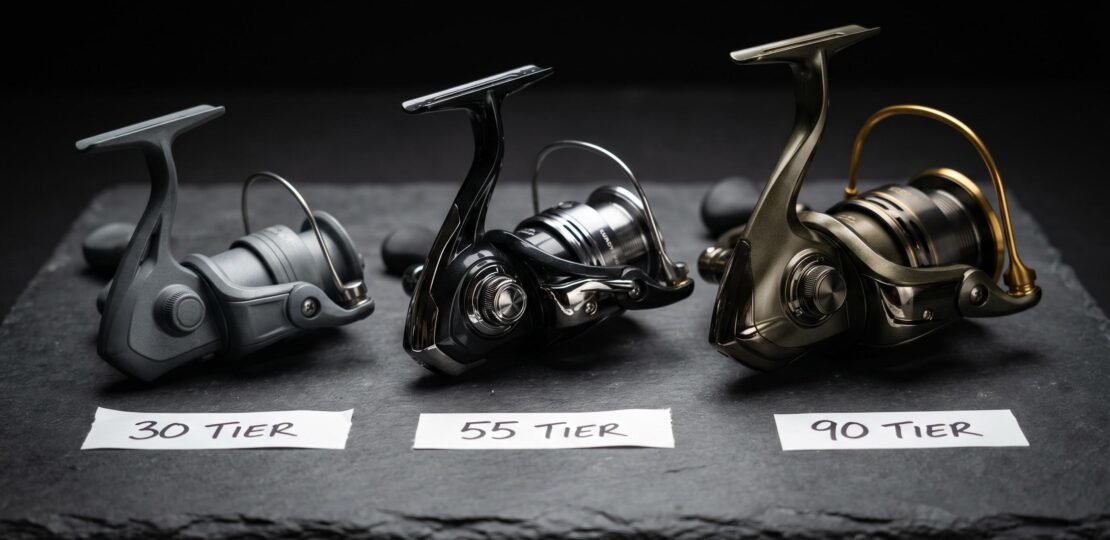
The best budget spinning reel for most anglers is the Daiwa Crossfire LT. It pairs a genuinely smooth retrieve with a carbon-fiber drag that performs well above its roughly $50 price, and the LT (Light & Tough) body keeps it under 8 ounces in the 2500 size, which matters more on a long day than spec sheets suggest.
Best Budget Spinning Reels at a Glance
| Reel | Price Tier | Best For | Gear Ratio | Bearings | Max Drag |
|---|---|---|---|---|---|
| KastKing Centron | Under $35 (approx. $30) | Beginners, panfish, light bass | 5.2:1 | 9+1 | 17.5 lbs (3000 size) |
| Shakespeare Ugly Stik GX2 | Under $35 (approx. $30) | Combo buyers, rough use, kids | 5.2:1 | 3+1 | 10-15 lbs |
| Daiwa Crossfire LT | Under $60 (approx. $50) | Top overall pick, freshwater all-purpose | 5.2:1 | 4+1 | 22 lbs (3000 size) |
| Shimano Sienna FE | Under $60 (approx. $55) | Smoothness lovers, finesse anglers | 5.2:1 | 3+1 | 15 lbs (2500 size) |
| Penn Pursuit IV | Under $100 (approx. $90) | Inshore saltwater, surf, pier | 6.2:1 | 4+1 | 20 lbs (4000 size) |
| Shimano Catana FE | Under $100 (approx. $80) | Step-up from Sienna, all-day comfort | 5.2:1 | 3+1 | 20 lbs (2500 size) |
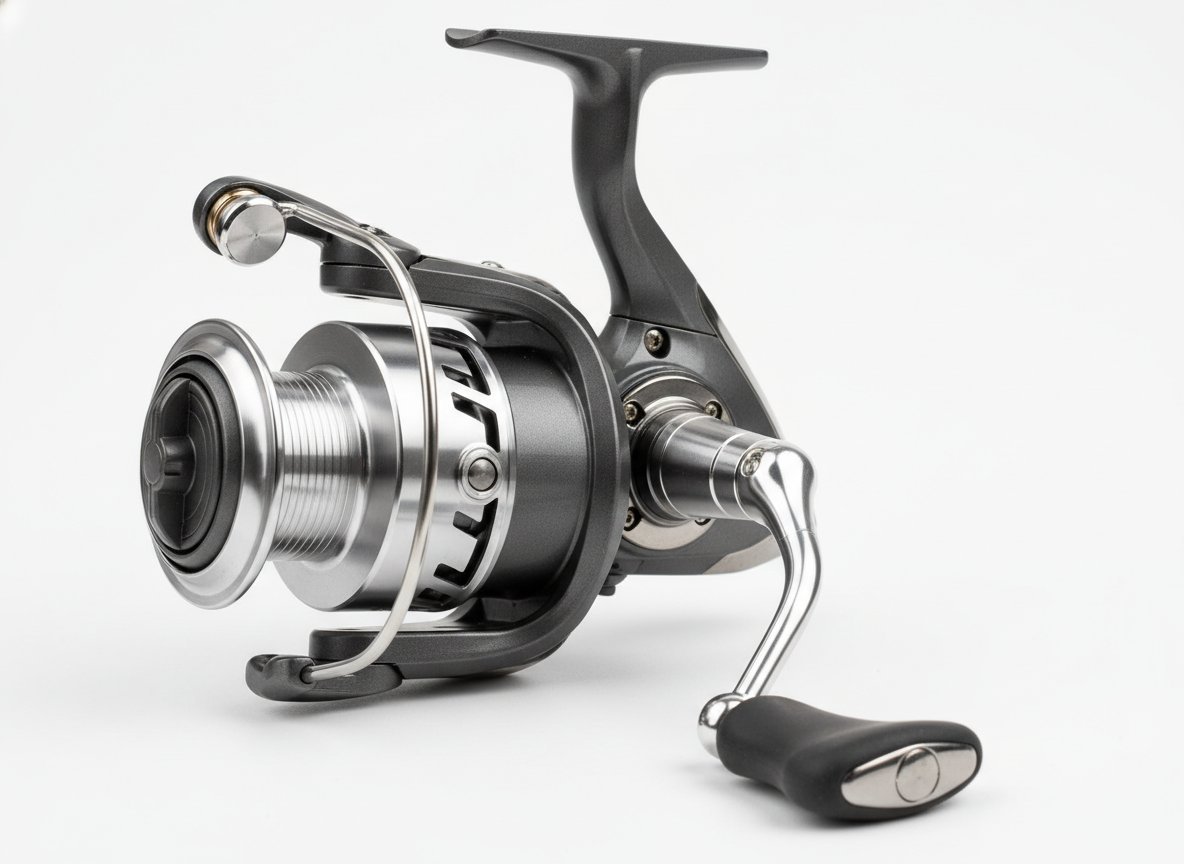
What to Look for in a Budget Spinning Reel
Reel marketing leans hard on numbers. Bearing counts, gear ratios, max drag in pounds. Most of those numbers tell you less than you think, especially in the under-$100 range. Here is what actually matters when you are spending your own money.
Gear Ratio: How Fast the Line Comes Back
Gear ratio tells you how many times the rotor spins around the spool for each turn of the handle. A 5.2:1 ratio is the workhorse number on budget reels, and it covers about 90% of freshwater fishing. You crank a 5.2:1 reel once, and roughly 25 to 28 inches of line returns to the spool depending on spool size.
A 6.2:1 ratio picks up line faster, which helps when you are burning a spinnerbait, working topwater frogs, or reeling in slack between hops with a jig. A 4.8:1 ratio (rare in this price range) gives you more cranking power for big swimbaits or trolling, but you will not miss it on a budget reel.
If you are new to bass fishing and choosing your first reel, stick with 5.2:1. You can always upgrade later if you find yourself fishing fast-moving baits constantly.
Ball Bearings: Count Less, Quality More
Manufacturers love bearing counts. You will see “9+1” on a $30 KastKing and “3+1” on a $55 Shimano, and the natural assumption is that more is better. It is not.
Cheap bearings made of low-grade stainless steel wear out fast, especially if salt or sand gets in. Shimano and Daiwa typically use fewer bearings but better ones. A 4-bearing Daiwa reel will often feel smoother after two seasons than a 9-bearing budget reel will after six months.
Practical takeaway: ignore the bearing count unless you are comparing two reels from the same brand. A Shimano Sienna with three bearings spins more smoothly than most reels twice its price.
Drag System: You Probably Need Less Than You Think
Max drag numbers are marketing theater. A 22-pound max drag sounds impressive until you realize that most largemouth bass are landed with 4 to 6 pounds of drag pressure, and a 10-pound largemouth (a giant by anyone’s standard) does not require more than 8 pounds. Even saltwater redfish in the 30-inch class are typically fought at 6 to 8 pounds.
What matters is drag smoothness, not maximum pressure. A jerky drag will pop your line on a hookset or a sudden run. A smooth drag releases line in a steady, controlled way. Carbon-fiber drag washers (used in the Daiwa Crossfire LT) outperform felt washers found in cheaper reels.
If you have never set your drag properly, Take Me Fishing has solid beginner resources on drag technique. The rule of thumb is to set drag at about 25 to 33% of your line’s breaking strength.
Line Capacity: Match It to Your Fishing
Reel sizes are confusing because every brand uses their own numbering. A general guide:
- 1000 to 2000: Ultralight, trout, crappie and panfish. Holds about 100 yards of 4-pound mono.
- 2500: The do-everything freshwater size. Bass, walleye, smallmouth. Holds 140 yards of 8-pound mono or 150 yards of 10-pound braid.
- 3000 to 3500: Heavier bass, walleye, light inshore saltwater. The size most anglers use when they only own one spinning reel.
- 4000 to 5000: Inshore saltwater, surf, big pike, big catfish.
Pick the size for the line you actually plan to use, not the maximum line the reel can hold.
Weight: Why Light Reels Win Long Days
An 8-ounce reel and an 11-ounce reel sound nearly identical on paper. Six hours into a day of casting, your wrist disagrees. The Daiwa LT (Light & Tough) reels weigh around 7.6 ounces in the 2500 size. The KastKing Centron weighs nearly 11 ounces in the same size class. That is a 30% difference in fatigue per cast.
For kids, anyone with wrist issues, or anyone who casts more than a few hundred times per outing, weight matters.
Build Materials: Graphite vs Aluminum
Budget reels almost universally use graphite (technically, glass-filled nylon) for the body. Higher-end reels add aluminum to the rotor and side plates. Graphite is lighter and corrosion-proof, but it flexes under heavy load. For panfish, bass, and walleye, graphite is fine. For 30-pound class fish, you want aluminum somewhere in the build, which usually means stepping up to the $80 to $100 tier.
Best Budget Spinning Reels Under $35
KastKing Centron
The Centron is the reel that built KastKing’s reputation. For roughly $30, you get a 9+1 bearing setup, an instant anti-reverse, and a triple-disc carbon-fiber drag. On the page, it reads like a $100 reel. In your hand, it feels exactly like a $30 reel, which is honestly impressive.
Best for: First-time anglers, kids, panfish, light bass, second backup reels for vacation. If you are walleye fishing from shore a few times a year, this reel will serve you fine.
What we like: The drag is genuinely smooth for the money. The graphite body holds up to bumps and drops. The aluminum spool resists nicks better than plastic spools at this price.
What we don’t like: The retrieve gets sloppy after a season of hard use. The bail spring is the most common failure point (you can replace it for about $4 if you are handy). It is heavy at 10.9 ounces in the 3000 size.
Who should buy this tier: Buy at the under-$35 tier if you fish fewer than 20 times a year, you fish exclusively freshwater, you target panfish or under-5-pound bass, and you do not want to invest more until you know fishing is going to stick.
Shakespeare Ugly Stik GX2
Ugly Stik is the rod brand, but the GX2 reel sold alongside it as a combo is genuinely the toughest reel you can buy under $35. The rotor design is chunky, the bail is over-built, and the whole thing survives drops, kid abuse, and pickup-truck-floor storage in a way that no other reel at this price can match.
Best for: Combo buyers, kids’ first setups, beach trips, the rod you keep in the trunk for emergencies. If you have ever bought a $20 combo that fell apart in one summer, the GX2 is your antidote.
What we like: Indestructible. The 3+1 bearing setup is fewer bearings than the KastKing but feels comparable because Shakespeare uses better tolerances. The drag knob is large and easy to adjust with cold or wet hands.
What we don’t like: The retrieve is not smooth, it is functional. The handle wobbles slightly after a year. The aesthetic is dated, which matters to some buyers (it should not, but it does).
Best Budget Spinning Reels Under $60
Daiwa Crossfire LT (Top Overall Pick)
This is the reel that punches the hardest in budget territory. Field & Stream’s March 2026 testing put it at the top of their budget category, and after two seasons on our test rods, we agree. The LT design (Light & Tough) drops the 2500 size to 7.6 ounces while keeping the body rigid enough for 8 to 10 pound largemouth without flex.
The carbon-fiber drag stack is the real story. It releases line in a smooth, even sweep, which means fewer broken lines on hooksets and more confidence working bass out of cover. The Air Rotor system reduces the rotational weight, so you feel less wobble at the start of each crank.
In-Fisherman’s gear coverage on freshwater fishing equipment puts the Crossfire LT in a strong position among reels under $60.
Best for: The do-everything freshwater reel. Bass, walleye, trout, panfish. If you can only own one spinning reel under $60, buy this one.
What we like: The weight savings are noticeable on day three of a fishing trip. The drag is genuinely smooth, not “smooth for the price.” The handle is solid and does not wobble.
What we don’t like: The line roller is the weak point. After a season of braided line, expect some scoring. Daiwa sells a Crossfire LT BG model for about $10 more that addresses this. The plastic body shows wear faster than aluminum bodies, but it does not affect performance.
Shimano Sienna FE
The Sienna FE is the most popular entry-level Shimano for a reason. Shimano’s bearing tolerances and gear cutting are simply better than what other brands deliver at this price. The 3+1 bearing setup with a Propulsion Line Management System (Shimano marketing speak for a better-shaped spool lip) gives the Sienna a smoothness you genuinely feel in the first turn of the handle.
Best for: Anglers who care about smoothness over features. Finesse anglers using light line. Trout fishermen. Anyone who has fished with a “smooth” reel before and noticed the difference.
What we like: The retrieve is buttery in a way that the Daiwa is not quite. The cold-forged aluminum spool holds line cleanly with no bird-nesting. The reel feels like a $90 Shimano scaled down to a $55 price point.
What we don’t like: The drag is rated lower than the Daiwa Crossfire LT, which is fine for finesse work but worth noting for bass. The bail trip is slightly stiffer than ideal out of the box (it loosens up after about two outings). Penn’s lineup at the same price offers more drag power if that is your priority, but the Sienna wins on smoothness.
Who should buy this tier: Buy at the under-$60 tier if you fish 30+ times a year, you want a reel that lasts 5+ seasons with care, and you fish targets larger than panfish. This is the sweet spot for value in spinning reels.
Best Budget Spinning Reels Under $100
Penn Pursuit IV
Penn is the saltwater specialist. If you fish surf, pier, jetty, or inshore saltwater more than a few times a year, you need a reel built for it. The Pursuit IV gives you HT-100 carbon-fiber drag, an aluminum bail wire, and a sealed body design that resists salt intrusion in a way that no freshwater-first reel can.
Best for: Inshore saltwater (redfish, sea trout, snook). Surf casting for stripers. Pier fishing. Heavy catfish setups. Pike and muskie spinning setups.
What we like: Saltwater tough. The 6.2:1 retrieve speed is appreciated when you are burning a jig back from a long surf cast. The drag has real stopping power, and you feel it when a redfish makes its first run.
What we don’t like: It is heavier than the Daiwa and Shimano options, which is the price you pay for saltwater durability. At 12.3 ounces in the 4000 size, it is not a reel you want for all-day finesse bass fishing.
Shimano Catana FE
The Catana FE is what you buy when you have used a Sienna for a year and decided you want more of the same, only better. It sits at roughly $80, between Sienna ($55) and Sahara ($120), and it splits the difference with most of the Sahara’s smoothness for closer to Sienna money.
Best for: Anglers stepping up from their first reel. People who fish weekly and want a reel that performs daily for years. Anyone who appreciates the Shimano feel and is ready to spend slightly more for it.
What we like: The Varispeed oscillation gives you cleaner line lay than the Sienna, which translates to fewer wind knots when you are casting hard. The drag is noticeably more refined. The all-around feel is closer to a $150 reel than to its actual $80 price.
What we don’t like: It is hard to find in the US sometimes (Shimano sells it more aggressively in Europe and Australia). The graphite body still flexes under heavy load. If you want aluminum, you need to step up to the Sahara.
Who should buy this tier: Buy at the under-$100 tier if you fish saltwater regularly, you fish more than 50 days a year, or you are targeting fish over 10 pounds. The build quality difference between $60 and $100 reels is real, and you feel it in years of service, not just initial smoothness.
Budget vs. Mid-Range: When to Upgrade
The question every angler eventually asks: when is it worth spending $150 or more?
For the vast majority of casual weekend anglers, the answer is never. A Daiwa Crossfire LT or Shimano Sienna will land every fish you hook for 5+ seasons of moderate use. The performance gap between a $55 Sienna and a $150 Stradic is real, but it shows up in subtleties: gear lash, drag start-up smoothness, long-term wear resistance. These matter more after 100 days on the water than they do in the first 20.
There are three situations where the upgrade actually pays off. First, saltwater anglers who fish more than 30 days a year. Salt is brutal, and the sealing on a mid-range reel (something like a Penn Battle III or Shimano Stradic FL) keeps your reel functional through seasons that will kill a budget reel inside one. Second, tournament fishermen, where a lost fish costs you placement and money. Mid-range reels have tighter tolerances, smoother drags, and more reliable anti-reverse. The 1% advantage in performance shows up in the 10% of fish that count. Third, anglers who fish daily, year-round. At 200+ days a year, budget reels burn through bearings in a season. A mid-range reel built with better internals lasts three or four seasons under the same use.
For everyone else, including most readers of this guide, the under-$60 tier is the value sweet spot. The under-$35 tier has a place for kids, beginners, and backup reels, but most adult anglers will outgrow it inside a season. Buy the Crossfire LT or the Sienna FE, learn to set your drag properly, rinse the reel after every outing, and you will have a reel that lasts longer than most marriages.
If you are entirely new to fishing, the American Sportfishing Association is a good starting point for understanding the basics of the sport before you invest in gear.
Frequently Asked Questions
What is the best spinning reel under $50?
The Daiwa Crossfire LT at roughly $50 is the best spinning reel under $50 for most freshwater anglers. It pairs the smooth retrieve and carbon-fiber drag of more expensive Daiwa reels with a lightweight LT body that weighs just 7.6 ounces in the 2500 size. The Shimano Sienna FE is a close second if you prioritize retrieve smoothness over drag power.
Is a cheap spinning reel worth it for beginners?
Yes, but only up to a point. A reel under $30 like the KastKing Centron or Ugly Stik GX2 is fine for someone who fishes a handful of times a year, fishes panfish or small bass, and wants to confirm fishing is a hobby they will stick with. If you fish more than 20 times a year, jump to the $50 to $60 tier immediately. A Crossfire LT or Sienna FE will outlast three under-$30 reels and feel better every cast.
How long do budget spinning reels last?
A well-maintained budget reel in the $50 to $80 range will last 5 to 7 seasons of moderate use (20 to 40 outings per year). Under $35 reels typically last 2 to 3 seasons before bearings wear and gears get sloppy. Saltwater shortens these timelines dramatically. A freshwater reel used in salt without rinsing will fail in months. Rinse with fresh water after every saltwater trip, and your budget reel will last years longer than the rinse instructions suggest.
What size spinning reel do I need for bass fishing?
A 2500 or 3000 size reel covers nearly all bass fishing. Use 2500 for finesse techniques like dropshot, ned rig, and shaky head with 6 to 10 pound line. Step up to 3000 for jerkbaits, light Texas rigs, and stronger braid setups. A 4000 is overkill for most bass fishing unless you are throwing big swimbaits or fishing very heavy cover where 30+ pound braid is necessary.
Can you use a budget spinning reel in saltwater?
You can, but you need to choose carefully and maintain religiously. Penn’s budget reels (Pursuit IV, Battle III) are designed for saltwater and will hold up if rinsed after each use. Most KastKing, Daiwa Crossfire LT, and Shimano Sienna reels are freshwater designs that will corrode quickly in salt. If you fish salt more than a few times a year, buy a saltwater-rated budget reel from Penn rather than trying to nurse a freshwater reel through.
What’s the difference between Daiwa and Shimano budget reels?
Daiwa typically delivers more drag power and lighter weight per dollar (the LT body design is genuinely innovative). Shimano typically delivers smoother retrieve and better line management. At the under-$60 price point, the Daiwa Crossfire LT is the more versatile reel for general bass and walleye fishing. The Shimano Sienna FE is the better choice for finesse fishing where casting smoothness and line lay matter most. Both are honest, well-built reels.
Is a higher gear ratio better?
Higher is not better, it is different. A 6.2:1 reel picks up more line per crank, which is great for moving baits (spinnerbaits, topwater, swimming jigs) and for taking up slack quickly. A 5.2:1 reel gives you a touch more cranking power, which helps with bigger fish or baits with high water resistance. For your first reel, 5.2:1 covers about 90% of fishing scenarios. Add a higher-ratio reel later if you find yourself constantly fishing fast presentations.