Yellow Perch Fishing: The Complete Guide to Catching Perch Year-Round
October 1, 2026 | by Ian
How to Catch Yellow Perch
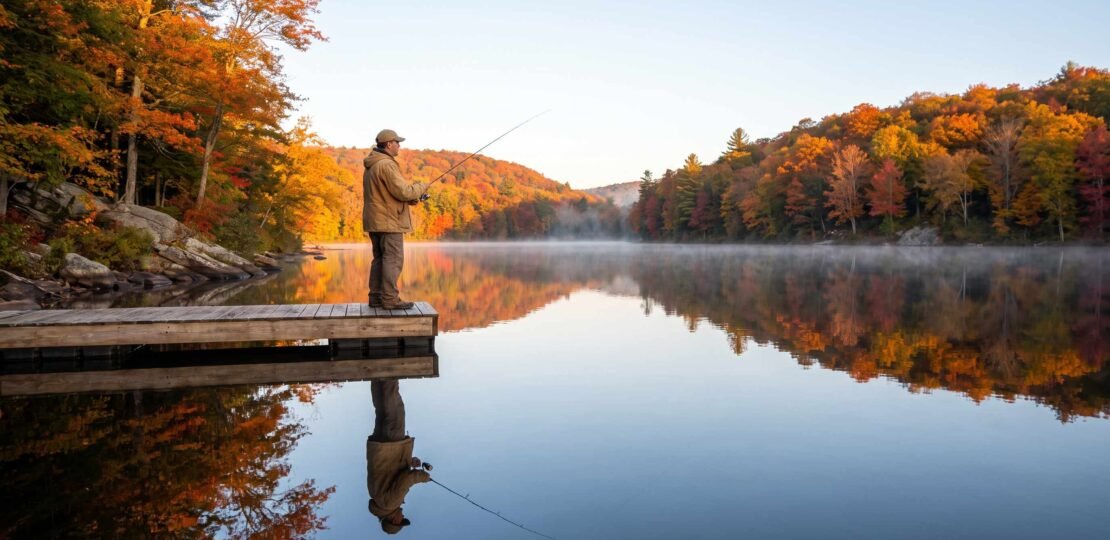
Yellow perch school near the bottom, so fish ultralight spinning gear with 4-6lb mono and 1/32-1/8oz jig heads tipped with small plastics or live minnows. Find them in shallow weeds in spring, deep weed edges in summer, and transitional structure like points and drop-offs in fall. Keep your bait within 6 inches of bottom.
Most perch guides tell you to “fish near the bottom with a jig” and leave it there. That advice is true, but it skips the part that actually puts fish in the bucket: finding the school. Yellow perch move in large groups, and those groups relocate on a predictable schedule driven by water temperature. Learn that schedule and you stop fishing empty water. This guide is built around what we call the Schooling Migration System. First you figure out where the perch are this week. Then you pick the rig and bait that match the depth and mood of the fish. Everything else follows from those two steps.
Why Yellow Perch?
Yellow perch are everywhere. According to the Oregon Dept of Fish & Wildlife, they are one of the most widely distributed panfish in North America, found naturally across the Great Lakes, the upper Midwest, the Northeast, and much of Canada, and introduced into reservoirs and natural lakes throughout the West. If you live in the northern half of the continent, there is a good chance a perch lake sits within an hour of your house.
How Big Do Yellow Perch Get?
Set your expectations realistically. In most waters, a typical yellow perch runs 6-7 inches. A 10-12 inch fish is a genuinely good catch, the kind you hold up for a photo. Anything 14 inches or longer counts as a trophy in most lakes, and fish that size usually weigh well over a pound. Some fisheries, like Lake Erie, Devils Lake in North Dakota, and parts of Lake Michigan, grow perch to “jumbo” status regularly, which is why anglers travel to them.
The Best-Tasting Fish in Freshwater?
Plenty of anglers would say yes. Yellow perch fillets are white, firm, mild, and slightly sweet, with none of the muddy flavor you sometimes get from warmwater species. They fry beautifully, and the Friday night perch fry is a cultural institution around the Great Lakes for good reason. Generous bag limits in many states make perch one of the few species where keeping a meal is both legal and sustainable. Always check your state regulations before you go, since limits vary widely.
Built for Schools
Here is the behavior that shapes every tactic in this guide. Yellow perch travel in dense schools, often sorted loosely by size, and they compete hard for food. When one perch sees a bait, several others rush it. That competitive feeding is why perch fishing tends to be feast or famine. You either catch nothing for an hour, or you catch fish on every drop for twenty minutes. When you find one perch, you have usually found hundreds. Your job is to find that first fish quickly, then stay on the school as long as it holds.
If you already chase other panfish, perch will feel familiar but not identical. They are more bottom-oriented than the suspended schools you target when you fish for crappie, and they roam more openly than the cover-hugging sunfish covered in our guide on how to catch bluegill. That roaming nature is exactly why tracking the school matters so much.
Understanding the School Migration
This is the heart of the guide. Perch schools do not wander randomly. They follow food, spawning needs, oxygen, and comfort, and all four of those factors track closely with water temperature. A cheap thermometer or the temp readout on your fish finder becomes your most important tool. Below is the seasonal cycle broken down by temperature triggers. Dates shift with latitude, so a lake in southern Ohio runs a few weeks ahead of one in northern Minnesota. Trust the thermometer over the calendar.
Spring Spawn: 45-55°F
As ice leaves and water warms into the mid-40s, perch push shallow to spawn. Depending on latitude, this happens anywhere from late March through May. Look for them in 4-9 feet of water over hard bottom, gravel, sand, or rock, with some submerged vegetation, brush, or old weed stalks nearby. Females drape long, accordion-like ribbons of eggs over that cover. Shallow bays on the north side of a lake warm first because they catch the most sun, so start there. Pre-spawn females are heavy and feed aggressively, which makes early spring one of the best times to catch a true jumbo.
Post-Spawn and Early Summer: 55-65°F
Once spawning wraps up, perch hang around the shallows to recover. New weed growth provides cover and a buffet of insect larvae, small crayfish, and young-of-year baitfish. Perch in this window are some of the easiest of the year to catch. They feed often and hit a wide range of baits. Fish the edges and pockets of emerging weed beds in 5-12 feet. The fish can scatter a bit more now, so cover water until you get bit, then slow down.
Midsummer: 65-75°F
When surface water gets warm, the bigger perch slide deeper. They suspend along deep weed edges and basin structures in 15-25 feet, often just above or along the thermocline where oxygen and temperature hit a sweet spot. Smaller perch often stay shallow in the weeds, which is why anglers complain about “nothing but dinks” in July. If you want quality fish in summer, go deeper. Main-lake humps, the outside edge of the weedline, and soft-bottom flats near the basin all hold schools. This is also prime water for walleye, and many of the same spots you would use to catch walleye produce perch too. Perch are a primary walleye forage, so the two species often share structure.
Fall Staging: 50-60°F
Fall is when the migration system really pays off. As water cools from 60°F toward 50°F, perch leave summer haunts and stage on transitional structure: points, drop-offs, rock piles, and the edges where weeds are dying back. They are feeding hard to bulk up for winter. In most of the northern US, that window falls squarely in October. The schools tighten up, which means fewer locations hold more fish. Find one productive break and you can often fill a limit without moving. We cover fall in detail further down.
Winter and Ice Season: Below 40°F
Under the ice, perch move to deep basins in 20-40 feet, especially soft mud bottoms where bloodworms and other insect larvae live. Their metabolism slows, but they keep schooling and keep feeding. The schools roam the basin floor, so a spot that is hot at 8 a.m. might be dead by 10. Mobility, a good flasher, and small baits win in winter.
Seasonal Location Table
| Season | Water Temp | Depth | Structure | Best Technique |
|---|---|---|---|---|
| Spring (pre-spawn and spawn) | 45-55°F | 4-9 ft | Hard bottom with vegetation, shallow bays, brush | Slip bobber with minnow, slow-swum 1/32oz jig |
| Early Summer (post-spawn) | 55-65°F | 5-12 ft | Emerging weed beds, weed pockets and edges | Small spinners, jig and grub, slip bobber |
| Midsummer | 65-75°F | 15-25 ft | Deep weed edges, humps, basin flats near thermocline | Tandem jig rig, drop shot |
| Fall | 50-60°F | 8-25 ft (shallower at dawn and dusk) | Points, drop-offs, rock piles, dying weed edges | Tandem jig rig, small crankbaits, spinnerbaits over weeds |
| Winter (ice) | Below 40°F | 20-40 ft | Deep mud basins, basin edges, near baitfish | Tungsten ice jig with spikes or minnow head, deadstick |
Reading the School When You Find It
Locating the school is half the battle. Keeping it is the other half. A few observations help. If you catch a perch and then nothing for ten minutes, the school has drifted. Perch schools move constantly, especially on wind-blown flats, so shift 20-50 yards downwind before abandoning the area. If you catch only small fish, try 5-10 feet deeper. Larger perch commonly sit at the outside edge of a school or slightly below it. And if you are catching fish steadily, do not leave fish to find fish. Mark the spot on your GPS or drop a marker buoy and work it until it dies.
Yellow Perch Gear Setup
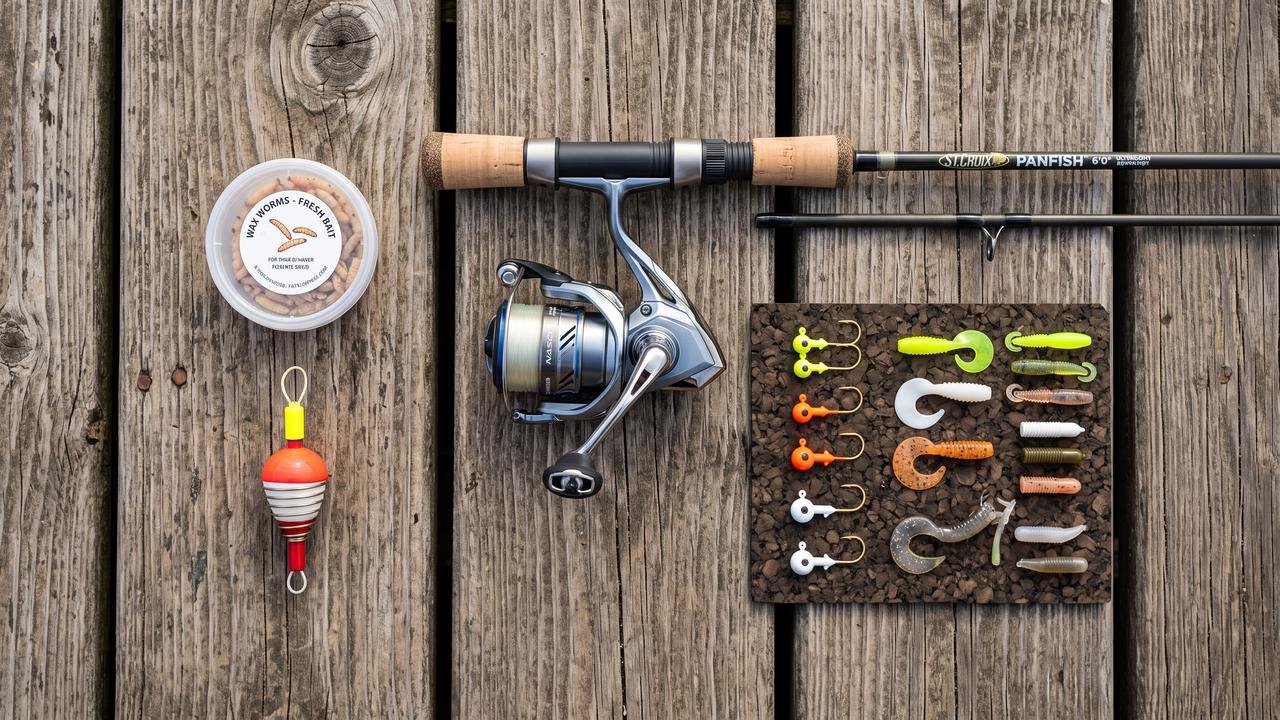
Perch do not require expensive gear. They do reward light, sensitive gear. Perch often bite delicately, especially in cold water, and a stiff bass rod with 12lb line will miss half your bites. Here is what we suggest.
Rod
Choose a 5’6″ to 6’6″ ultralight or light power spinning rod with a fast action. The light power lets a 1/32oz jig load the rod on the cast. The fast tip transmits tiny ticks and lets you set the hook with a short snap. A 6′ or 6’6″ length gives you a bit more casting distance from shore, while a 5’6″ rod is easier to manage in a small boat or when vertical jigging. Graphite blanks are more sensitive than fiberglass, which matters when you are feeling for light bites 20 feet down.
Reel
A 1000 or 2000 size spinning reel balances an ultralight rod perfectly. Look for a smooth drag and at least five or six ball bearings. You do not need a high-speed retrieve. Perch fishing is mostly about slow presentations and vertical work.
Line
Spool up with 4-6lb monofilament for most situations. Mono is forgiving, inexpensive, and its slight stretch keeps you from ripping hooks out of a perch’s thin mouth. In clear water or when fishing deep, 4-6lb braid with a 6-inch to 2-foot fluorocarbon leader of 4-6lb gives you better sensitivity and a nearly invisible connection at the business end. Braid shines in 20+ feet, where mono stretch can mute bites. Hi-vis braid also helps you watch for line ticks.
Gear Comparison by Budget
| Tier | Rod | Reel | Line | Total |
|---|---|---|---|---|
| Budget (under $60) | Ugly Stik GX2 Ultralight 5’6″ or Shakespeare Micro Series combo | Included in Ugly Stik GX2 combo, or Shakespeare Agility 1000 | Berkley Trilene XL 4lb mono (~$6) | $40-$60 |
| Mid-range ($60-$120) | Ugly Stik Elite 6′ Ultralight or Daiwa Ardito 6’6″ Light (~$45-$60) | Shimano Sienna 1000 or Daiwa Revros LT 1000 (~$40-$50) | PowerPro 5lb braid with Seaguar fluoro leader (~$25) | $90-$120 |
| Premium ($120+) | St. Croix Triumph 6′ Ultralight or St. Croix Panfish Series (~$110-$150) | Shimano Stradic 1000 or Daiwa Ballistic MQ LT 1000 (~$150-$230) | Sufix 832 4lb braid with Seaguar InvizX 4lb leader (~$35) | $280-$400 |
Honestly, the budget setup catches perch just fine. The jump to mid-range buys you better sensitivity and a smoother drag, which helps in deep water and cold weather. Premium gear is a luxury, but if you fish perch 30 days a year, a light, crisp St. Croix blank paired with a Stradic makes long days on the water far more pleasant. Whatever you pick, buy a few extra spools of line. Perch fishing around rocks and weeds chews through tippet, and fresh line casts and feels better.
Other Gear Worth Packing
- Fish finder: Even a basic $100-$150 unit like a Garmin Striker 4 or Humminbird Helix 5 shows depth, bottom hardness, and fish marks. Perch schools show up as clusters tight to bottom.
- Water thermometer: Your migration compass. Many fish finders include one.
- Disgorger or small needle-nose pliers: Perch swallow baits, especially live minnows.
- Bucket or livewell with aeration: If you plan to keep fish, keep them alive and cool for better fillets.
- Marker buoy: Drop it on the school so you can return after a drift.
Best Rigs for Yellow Perch
Four rigs cover nearly every perch situation you will face. Each matches a specific depth and fish mood, so pick based on where the school sits in its seasonal migration.
1. Tandem Jig Rig (Perch Spreader Style)
This is the most productive open-water perch rig we know, and it is a favorite on the Great Lakes. Two small jigs fished together let you test two colors or baits at once and often hook doubles when the school is feeding hard.
How to tie it:
- Tie a 1/16-1/8oz jig head (or a small bell sinker for a weight-at-bottom version) to the end of your main line. This anchors the rig on the bottom.
- About 12-18 inches above that, tie a dropper loop, a simple loop that stands off the main line. Make the loop 3-4 inches long.
- Thread a 1/32oz jig head or a size 6 hook through the loop using a loop-to-loop connection, or cut one side of the loop to create a tag line and tie the second jig directly to it.
- Tip both jigs with a small plastic grub, a minnow head, or a piece of nightcrawler.
Drop the rig straight down until the bottom jig touches. Lift a few inches, hold, then let it fall back. Most bites come as the rig settles. In summer and fall, when perch sit in 15-25 feet, this rig shines because it stays vertical and keeps both baits in the strike zone. If you use a sinker on the bottom, the upper jig rides 12-18 inches off the floor, right where perch cruise.
2. Slip Bobber Rig
A slip bobber lets you suspend a bait at any depth while still casting easily. That makes it perfect for spring and early summer, when perch sit in 4-12 feet around weeds, and for shore anglers who cannot fish vertically.
To set it up, slide a bobber stop (a knot of thread or a rubber stop) onto your main line, followed by a small bead and a slip bobber in the 1/2 to 1 inch range. Tie on a size 6-8 hook or a 1/32oz jig, and pinch a split shot 8-12 inches above it. Adjust the bobber stop so your bait hangs 6 inches off the bottom. To find bottom, clip a heavy split shot to the hook, cast, and slide the stop until the bobber just sits upright. Then back it off a few inches.
The biggest mistake with slip bobbers is setting the bait too high. Perch hug the bottom. A minnow 3 feet up in 8 feet of water gets ignored while the school feeds below it.
3. Drop Shot Rig
Bass anglers made the drop shot famous, but it works brilliantly for perch, especially when they are finicky or holding in a precise depth band. The weight sits on the bottom and the hook rides above it, so you control exactly how far off bottom your bait floats.
Tie a size 6-8 drop shot hook with a Palomar knot, leaving a 12-18 inch tag end. Pass the tag back through the hook eye from the top so the point faces up. Attach a 1/8-1/4oz drop shot weight to the tag end. Nose-hook a 1.5-2 inch plastic minnow or worm, or a live minnow through the lips. Shorten the leader to 4-6 inches when perch are tight to bottom. Lengthen it to 12 inches when you see them on sonar a foot or more off the floor.
Work it by lifting the rod slightly and shaking the tip, letting the bait quiver in place. A drop shot keeps your bait in one spot longer than any other rig, which is ideal over a school you have pinned on electronics.
4. Basic Bottom Rig with Live Bait
Sometimes simple wins. A basic bottom rig is the easiest perch setup for beginners, kids, and pier fishing. Slide a 1/8-1/4oz egg sinker onto your main line, add a bead, then tie on a small barrel swivel. Attach 12-18 inches of 4lb leader and finish with a size 6-8 baitholder or Aberdeen hook. Bait with a piece of nightcrawler, a wax worm, or a small minnow and cast it out.
Let it sit, keep the line just slightly tight, and watch the rod tip. When perch pick at it, you will see small taps. Wait for a steady pull, then lift. A long-shank Aberdeen hook makes unhooking easier, since perch tend to inhale live bait.
Rig Comparison Table
| Rig | Best For | Water Depth | Bait | Skill Level |
|---|---|---|---|---|
| Tandem Jig Rig | Open-water schools, testing two baits, doubles | 10-35 ft | Grubs, minnow heads, crawler pieces | Intermediate |
| Slip Bobber Rig | Shallow weeds, shore fishing, precise suspension | 4-20 ft | Live minnows, leeches, wax worms | Beginner to Intermediate |
| Drop Shot Rig | Finicky fish, pinned schools on sonar | 10-30 ft | Small plastics, live minnows | Intermediate |
| Basic Bottom Rig | Beginners, kids, piers and docks | 5-25 ft | Nightcrawler pieces, wax worms, minnows | Beginner |
Best Baits and Lures for Yellow Perch
Perch eat almost anything small that moves near the bottom: minnows, insect larvae, crayfish, snails, and the occasional baby perch. That broad diet means plenty of baits work. The trick is matching size and presentation to the season.
Artificial Lures
Jig heads with small plastics. This is the backbone of artificial perch fishing. Use 1/32-1/16oz jig heads in shallow water and bump up to 1/8oz in deeper water or wind. Thread on a 1.5-2 inch curly-tail grub, a small tube, a paddle-tail swimbait, or a tiny minnow-profile plastic. Brands like Bobby Garland, Z-Man, Berkley PowerBait, and Southern Pro all make perch-sized options. The same micro-jigs that dominate our list of the best crappie lures work perfectly for perch. If you already carry a crappie box, you are 90 percent ready. Hop the jig along the bottom with short 2-4 inch lifts, letting it fall back on a semi-slack line.
Small crankbaits. When perch are scattered across a flat or you need to locate a school, small crankbaits let you cover water fast. Look for baits in the 1.5-2 inch range, like the Rapala Ultra Light Crank or Berkley Frenzy Micro Crank. Choose a diving depth that ticks bottom occasionally. When you hook a fish, stop and switch to a jig to work the school.
Inline spinners. A Worden’s Rooster Tail in 1/16-1/8oz is a classic perch killer, especially in spring and early summer around weeds. Cast it out, count it down close to bottom, then retrieve just fast enough to keep the blade turning. Yellow, white, and chartreuse are reliable colors. Spinners also catch a lot of bonus fish, from crappie to small bass.
Blade baits and jigging spoons. In fall and winter, a 1/8-1/4oz blade bait or small jigging spoon like a Swedish Pimple or Johnson Splendex triggers reaction strikes from deep schools. Rip it up 6-12 inches and let it flutter back down. Many anglers tip the treble hook with a minnow head for scent.
Live Bait
Fathead minnows. Small fatheads, around 1-2 inches, are the single best perch bait overall. Hook them lightly through the lips or behind the dorsal fin and fish them on a slip bobber, drop shot, or plain jig. In cold water, a minnow head on a jig often outfishes a whole minnow because it stays put and releases scent.
Wax worms. These soft, pale grubs are an ice-fishing staple but work year-round. They are durable, cheap, and perch love them. Thread one or two onto a small jig or hook.
Small leeches. Ribbon leeches excel in summer, especially for bigger perch. They wiggle constantly, which draws strikes from fish that ignore static baits.
Nightcrawler pieces. A 1-inch chunk of crawler on a size 6-8 hook catches perch anywhere. It is the easiest bait to find and works great for beginners. The downside is that small perch and other panfish strip it fast.
Perch eyes and meat. Old-school anglers use a perch eye or a small strip of belly meat on a jig. Check your local regulations first, since some states restrict using game fish parts as bait.
The 6-Inch Rule
Here is the single most important bait principle in perch fishing: stay within 6 inches of the bottom. Perch feed near the bottom even when they are inactive, and they rarely rise far to chase a meal. A jig dragging along the floor or a minnow suspended just off it will outfish a bait a few feet higher almost every time. When you are not getting bites and you know fish are present, lower your bait before changing anything else.
Lure and Bait Comparison Table
| Type | Best Season | Depth Range | Retrieve | Skill Level |
|---|---|---|---|---|
| Jig head with grub or tube (1/32-1/8oz) | Year-round | 4-35 ft | Short hops along bottom, slow fall | Beginner |
| Small crankbait (1.5-2 in) | Early summer, fall | 4-12 ft | Steady retrieve ticking bottom | Beginner |
| Inline spinner (Rooster Tail 1/16-1/8oz) | Spring, early summer | 3-12 ft | Count down, slow steady retrieve | Beginner |
| Blade bait or jigging spoon | Fall, winter | 15-40 ft | Short vertical rips, flutter on fall | Intermediate |
| Fathead minnow | Year-round | 4-40 ft | Suspended or slowly jigged | Beginner |
| Wax worms | Winter, spring | 4-40 ft | Tipped on jig, deadstick or slow jig | Beginner |
| Leeches | Summer | 8-25 ft | Slip bobber or drop shot | Beginner |
| Nightcrawler pieces | Spring through fall | 4-25 ft | Bottom rig or bobber, static | Beginner |
Fall Perch Fishing: Your October Advantage
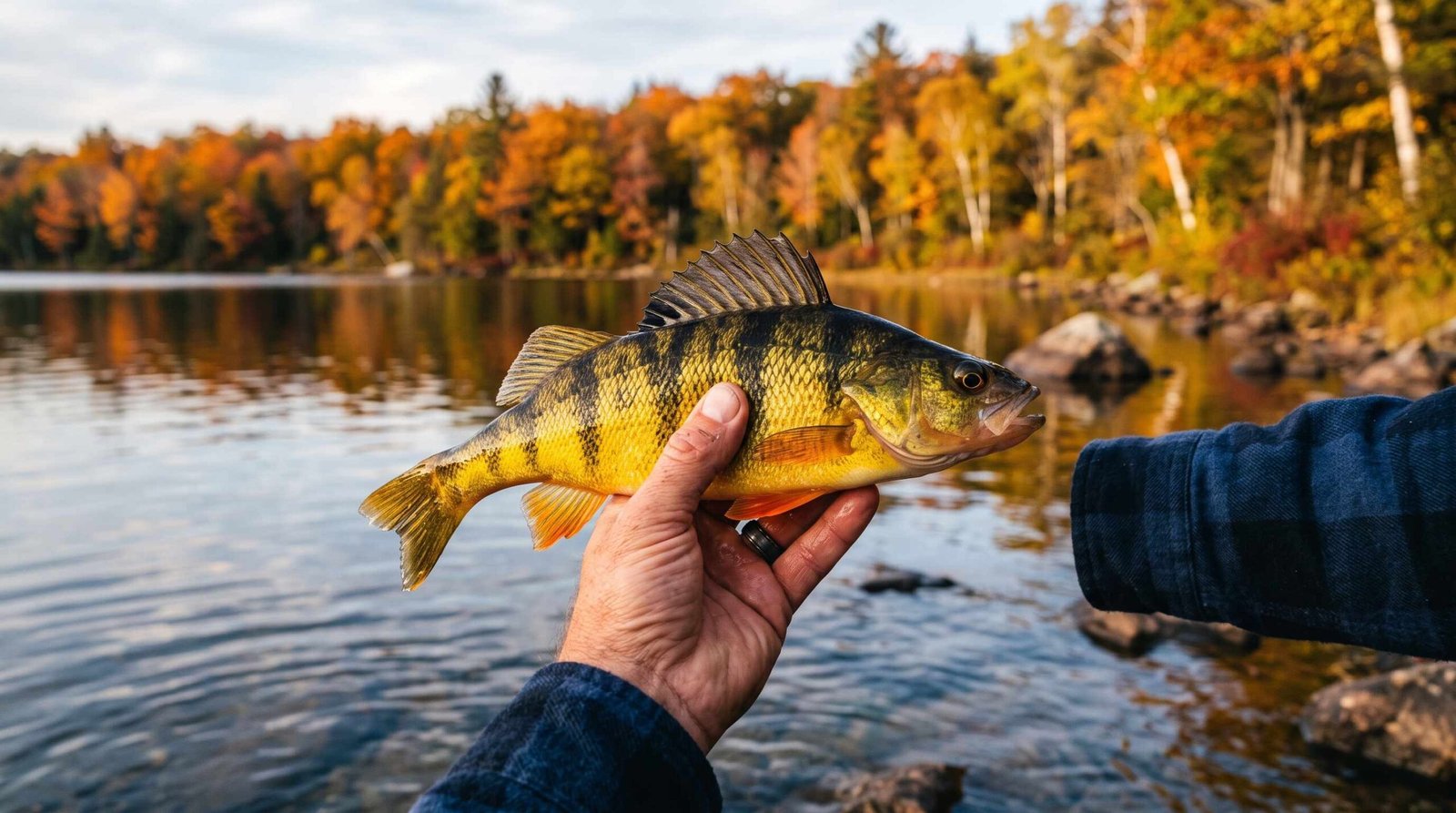
If you only pick one season to chase perch in open water, make it fall. October offers cooler weather, fewer boats, and perch that are feeding with real urgency. The fish know winter is coming. They are fattening up, and the biggest perch in the lake are often the most aggressive.
The 55-Degree Trigger
Watch your surface temperature. When it drops to around 55°F, perch kick into a pre-winter feeding binge. Baitfish schools that were spread across the lake all summer begin consolidating, and perch follow them. This is the moment the migration system becomes most predictable. Schools tighten up and relocate to a handful of key structural spots, and they stay there for weeks at a time.
Where to Look in Fall
Focus on three types of structure:
- Drop-offs: Sharp breaks from 8-12 feet down to 20-25 feet concentrate perch. They give the school quick access to both shallow feeding flats and deep resting water.
- Rocky points: Points that extend into the main lake attract baitfish and crayfish, and they hold heat a little longer than surrounding soft bottom. Work the tip and both sides.
- Transitioning weed edges: This is the hidden gem. Look for the line where green, living weeds meet brown, dying weeds. Healthy green weeds still produce oxygen and hold insects and baitfish, so perch stack along that boundary. Run your fish finder slowly along the weedline and watch for the change, or pull up a weed sample on your jig to check color.
These same fall spots also attract largemouth and smallmouth hunting for an easy meal. If you have ever worked fall points while trying to fish for bass, you already know the structure. Downsize your bait and you will find perch on the same breaks.
Timing: Dawn, Dusk, and the Midday Retreat
Larger perch move shallower at dawn and dusk, sometimes into 6-10 feet along the top of a break, to feed on baitfish. As the sun climbs, they slide back to the deeper edge of the same structure, often 18-25 feet. Follow them. Start the morning casting jigs or small crankbaits on top of the break, then switch to vertical tandem rigs or drop shots on the deep edge by mid-morning. Overcast, breezy days can keep perch shallow longer.
Fall Colors That Work
Chartreuse, yellow, and orange consistently produce in fall. These colors mimic the natural barring and fins of young perch, which adult perch do eat, and they stay visible as fall turnover stains the water. Gold blades and firetiger crankbaits are worth keeping tied on. In very clear lakes, switch to more subtle smoke, pearl, or natural minnow shades.
The Spinnerbait Trick for Trophies
Here is an approach that surprises a lot of anglers. Research and field reports from In-Fisherman highlight that larger perch will hit small spinnerbaits worked over weed edges. A 1/8 to 1/4oz spinnerbait with a small Colorado or willow blade, slow-rolled just over the tops of dying weeds, draws strikes from jumbo perch that ignore dinky jigs. You will also catch bass and pike, which makes it a fun way to search. When you connect with a big perch, slow down with a jig and grub to see if more are nearby.
Fall Game Plan Summary
- Check surface temp. Around 55°F, the binge is on.
- Locate drop-offs, rocky points, and green-to-brown weed transitions on a map or your sonar.
- Fish shallow edges at dawn with spinners, crankbaits, or spinnerbaits.
- Follow the school to deeper water midday with a tandem jig rig or drop shot.
- Use chartreuse, yellow, and orange.
- Mark every school you find. Fall schools often return to the same spots day after day.
Ice Fishing for Yellow Perch
When lakes freeze, perch fishing does not stop. It gets more popular. Vermont Fish & Wildlife notes that yellow perch are one of the most popular ice fishing targets, and across the northern US they are arguably the number one species pulled through the ice. They bite all winter, they school tightly, and they taste even better from cold water.
Ice Gear
Switch to a short 24-28 inch ice rod with a light or ultralight action. A sensitive spring bobber on the tip helps detect light bites. Spool a small spinning reel or inline reel with 2-3lb mono or fluorocarbon. Thin line lets tiny jigs fall naturally and cuts down on line visibility in clear winter water.
Your go-to lure is a 1/32-1/64oz tungsten jig. Tungsten is denser than lead, so a small jig sinks fast and transmits more feel, even in 30 feet. Tip it with two or three spikes (maggots), a wax worm, or a minnow head. Many anglers run a second line with a live minnow on a plain hook as a deadstick in a nearby hole.
Where to Drill
Start in 20-35 feet over basin areas, especially soft mud flats where insect larvae live. Pay attention to baitfish. Perch follow ciscoes, shiners, and other forage, so if your electronics show suspended bait, perch are often nearby on the bottom. Drill a line of holes across a basin edge and hop between them until you mark fish. Do not sit on a dead hole for more than 10-15 minutes.
Watch the School on Electronics
A flasher like a Vexilar FL-12 or a Garmin LiveScope turns ice fishing into a visual game. Drop your jig to the bottom, lift it a few inches, and watch the screen. When a fish mark rises to meet your jig, slow down and give the bait tiny shakes. Here is the key tip: when the flash of your jig disappears or merges with the fish mark, set the hook. That usually means a perch has inhaled the bait, even if you feel nothing. Perch often bite so softly in winter that your eyes catch the strike before your hands do.
Ice perch also share basins with walleye and pike. If you want to target the bigger predators at dusk, set a tip-up with a medium shiner while you jig perch in the next hole. It is one of the best combo days in winter fishing.
Common Yellow Perch Fishing Mistakes
A few errors cost anglers more fish than anything else. Avoid these and your catch rate jumps.
- Fishing too high in the water column. Remember the 6-inch rule. Perch feed on or just above the bottom.
- Staying on dead water. Schools move. If you have not had a bite in 15 minutes, relocate.
- Leaving active fish. When you are catching perch, stay put and mark the spot.
- Using line and hooks that are too big. Heavy line kills action on tiny jigs, and big hooks miss small mouths.
- Ignoring water temperature. The thermometer tells you where the school is going. Check it every trip.
- Settling for small fish. If you are catching only 6-inchers, move deeper or to the outside edge of the school to find bigger fish.
Yellow Perch Fishing FAQ
What is the best bait for yellow perch?
Small fathead minnows are the best overall bait for yellow perch. Hook a 1-2 inch fathead through the lips or behind the dorsal fin and fish it within 6 inches of bottom. Wax worms, small leeches, and nightcrawler pieces also work well. For artificials, a 1/32-1/16oz jig with a 1.5-2 inch grub or tube catches perch year-round.
How deep do you fish for perch?
Perch depth depends on the season. In spring they spawn in 4-9 feet over hard bottom. In early summer they hold in 5-12 feet around weeds. Midsummer pushes larger perch to 15-25 feet along deep weed edges. In fall they stage in 8-25 feet on points and drop-offs, and in winter they move to deep basins in 20-40 feet.
What size hook is best for yellow perch?
A size 6 or 8 hook is ideal for yellow perch. Perch have relatively small mouths, so oversized hooks miss bites. Long-shank Aberdeen or baitholder hooks make unhooking easier, since perch often swallow live bait. For jigs, choose 1/32-1/8oz heads with a size 6-8 hook, scaling up the weight in deeper water or wind.
What time of day are perch most active?
Perch are daytime feeders, with peaks in early morning and late afternoon into dusk. Larger perch often move shallow at dawn and dusk to feed, then retreat to deeper structure during midday. Unlike walleye, perch go quiet after dark and settle on the bottom, so night fishing for them is rarely productive. Overcast days can extend shallow feeding windows.
Can you catch perch from shore?
Yes. Shore fishing for perch is very productive in spring and fall, when schools move shallow. Target piers, breakwalls, rocky points, and spots where deep water sits close to shore. A slip bobber rig or basic bottom rig with a minnow or crawler piece works best. A 6-6’6″ ultralight rod helps you cast small baits farther.
What is a trophy-sized yellow perch?
In most waters, a yellow perch of 14 inches or longer is considered a trophy, typically weighing over a pound. A 10-12 inch perch is a good fish, while the average catch runs 6-7 inches. Some fisheries like Lake Erie, Lake Michigan, and Devils Lake regularly produce jumbos, and the world record weighed over 4 pounds.
How do you find a school of perch?
Start with water temperature to determine the seasonal location, then search matching structure: shallow weeds in spring, deep weed edges in summer, points and drop-offs in fall, and deep basins in winter. Use a fish finder to spot tight clusters near the bottom. Cover water with small crankbaits or spinners until you catch one, then slow down.
What is the best rod and reel for perch fishing?
We suggest a 5’6″ to 6’6″ ultralight or light power spinning rod with fast action, paired with a 1000-2000 size spinning reel and 4-6lb line. The Ugly Stik GX2 Ultralight combo is a great budget choice. For more sensitivity, a St. Croix Triumph Ultralight with a Shimano Stradic 1000 is hard to beat.
Putting the Migration System to Work
Yellow perch fishing comes down to two questions: where is the school, and how do I keep my bait in front of it? Answer the first with water temperature and seasonal structure. Answer the second with light gear, small baits, and the discipline to stay within 6 inches of the bottom. Start each trip by checking the temperature, matching it to the seasonal table above, and heading to the right structure. Pick the rig that fits the depth. Then fish fast until you find them and slow down once you do. Follow that system and you will catch more perch, bigger perch, and enough for a fish fry that keeps your friends asking where you found them.
RELATED POSTS
View all