Catfish Rig Setup Guide: Rod, Line, and Complete System for Channel, Blue, and Flathead Cat
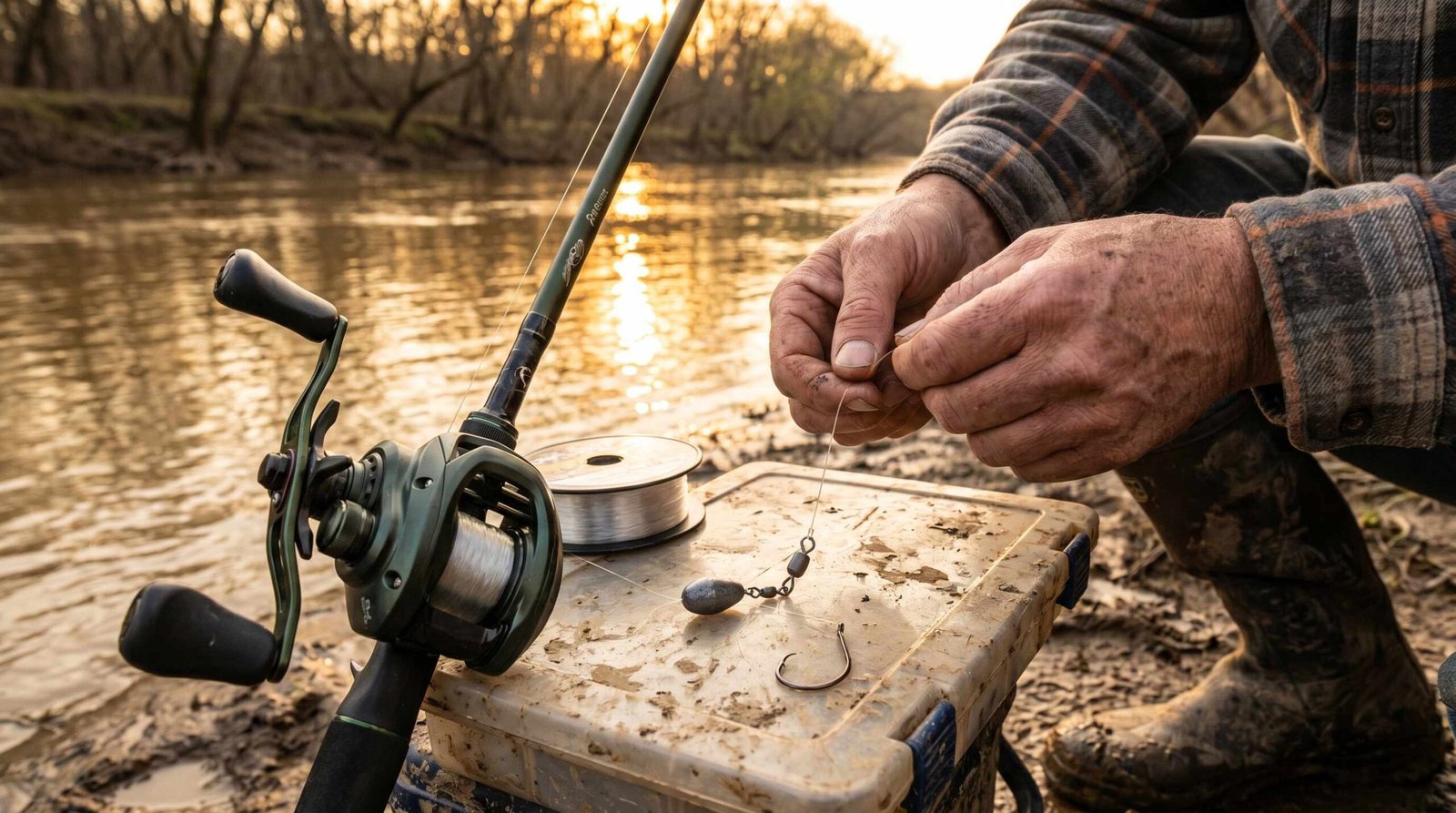
Most catfish guides treat your rod, your reel, your line, and your rig as separate purchases. They’re not. They’re a single connected system, and getting any one piece wrong can sabotage the other three. A heavy 8-foot rod paired with 10-pound line is going to snap that line on the first decent fish. A fast-action tip with a circle hook will yank the bait out of the fish’s mouth before the hook ever finds the corner. A 1-ounce sinker in a heavy river current will drift sideways for 50 yards before settling.
This guide ties everything together. We’ll walk through how to pick a rod that matches the rigs you actually plan to fish, how to size your line to the rig and the species, and how to assemble the four rigs that cover every catfish situation you’ll encounter. Then we’ll get into species-specific setups for channels, blues, and flatheads, because each one demands a slightly different system.
Quick Answer: A complete catfish rig setup includes a medium-heavy 7- to 8-foot rod, a baitcasting or spinning reel spooled with 15-30 lb monofilament or 30-65 lb braided line, and a slip sinker rig tied with a 1- to 3-ounce egg sinker, a barrel swivel, an 18- to 24-inch monofilament leader, and a 2/0 to 6/0 circle hook. This combination covers roughly 90% of catfish situations from bank to boat.
The Three Building Blocks of Any Catfish Setup
Before we touch a single rig, you need to understand that your rod, reel, and line are three legs of a stool. Pull one out from under and the whole thing tips over. Here’s how the three pieces talk to each other.
Picking the Right Rod for Catfish
For 90% of catfishing, you want a medium-heavy power rod between 7 and 8 feet long with moderate-fast action. That’s not a vague suggestion. Each part of that spec exists for a reason.
The length gives you casting distance from the bank and a long lever for fighting big fish away from cover. The medium-heavy power handles 1- to 4-ounce sinkers without folding over, which is the weight range you’ll fish in most rivers and lakes. The moderate-fast action is the part most beginners get wrong. If you’re fishing circle hooks (and you should be), a fast-action tip is too stiff at the tip. It snaps the hook out of the fish’s mouth instead of letting the fish pull the hook into the corner of the jaw. Moderate-fast bends through the upper third, loading slowly as the fish pulls, which is exactly how a circle hook is designed to set.
If you’re targeting big blues or flatheads in heavy cover, step up to a heavy power rod in the 7’6″ to 8′ range. If you’re fishing small streams for eating-size channels, drop to a medium power in the 6’6″ to 7′ range. For a deeper breakdown of pairings, our catfish combo rod and reel guide walks through specific length and power combinations for different fishing styles.
Choosing a Reel That Works with Your Rod
Two options dominate catfishing: baitcasters and large-spool spinning reels. Both work, but they work differently.
A baitcaster gives you better line control, more cranking power, and easier handling of heavy sinkers and big baits. Look for a round-profile baitcaster with a clicker (the audible bait alarm that lets you fish with the reel in free-spool while you wait for a bite). Models like the Abu Garcia Ambassadeur 6500 series and the Penn Squall are workhorses. Pair a baitcaster with a casting rod that has a trigger grip, not a spinning rod. The line guides face down on a casting rod and up on a spinning rod, so the two are not interchangeable.
A spinning reel makes more sense for beginners, lighter setups, or when you’re targeting channel cats up to about 15 pounds. Look for a 4000 to 6000-size reel with a bait-feeder system (sometimes called a “live liner” or “free-spool” feature), which lets the fish take line freely until you flip the bail. Anything smaller than a 4000 will struggle with heavy sinkers and big fish.
Whatever you choose, make sure the reel is rated for the line weight you actually plan to fish, and that the drag is smooth and strong enough to handle the species you’re targeting. We get into rod-reel matching in more depth in our best catfishing combos roundup.
Line Selection: Monofilament vs. Braid
This is where the system thinking really matters. Your line choice depends on your rig, your target species, and the cover you’re fishing in.
Monofilament in 15 to 30-pound test is the traditional choice for channel cats and smaller blues. It stretches, which softens the hookset and gives you a forgiving fight. It’s cheap, easy to tie, and abrasion-resistant when you size it up. For a slip sinker rig in open water, 17 to 20-pound mono is hard to beat.
Braided line in 30 to 65-pound test shines when you need power, sensitivity, or thin diameter for casting distance. It has zero stretch, which transmits every bump straight to the rod tip. The lack of stretch also means a harder hookset, which is why we suggest pairing braid with a moderate-fast rod that absorbs some of the shock. Braid is the right call for heavy cover, big blues, flatheads in timber, and any situation where you’re feeding line through brush.
One pitfall: braid is not abrasion-resistant in the way mono is. If you’re fishing rocky bottom or timber, run a mono or fluorocarbon leader off your braid mainline. The braid handles the casting and the hookset, the leader handles the rubbing against structure.
Four Catfish Rigs and When to Use Each
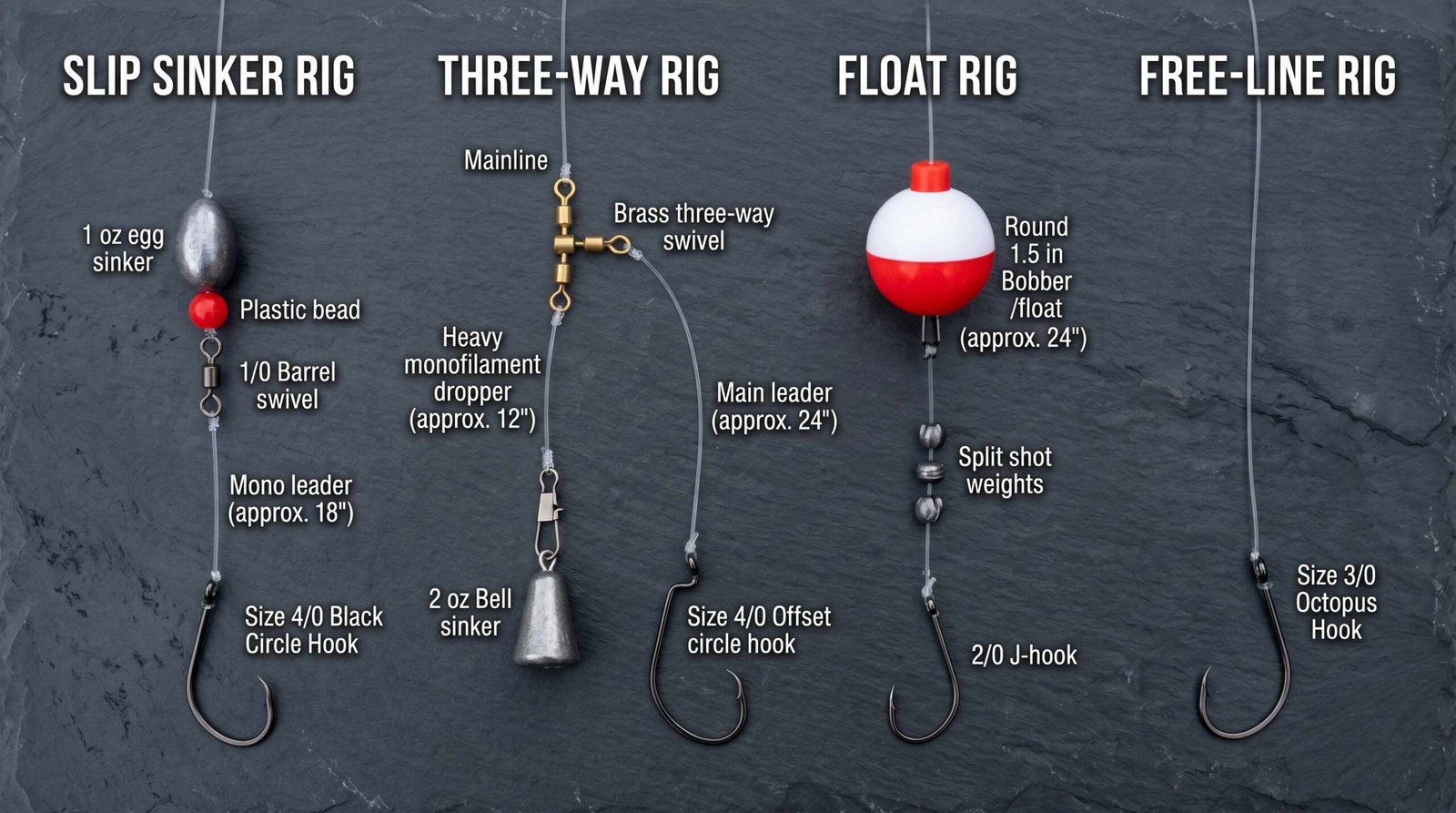
There are dozens of catfish rigs floating around the internet, but four of them cover every realistic situation. Each rig solves a specific problem. Pick the one that matches the water you’re fishing, not the one that looks coolest in a YouTube thumbnail.
The Slip Sinker Rig (Go-To for Most Situations)
The slip sinker rig is the most-used catfish rig in North America, and for good reason. It works in still water, light current, lakes, ponds, and slow rivers. The egg sinker slides freely on your mainline so the fish can pick up the bait and move off without feeling the weight, then a barrel swivel stops the sinker and a leader runs to a circle hook. When a cat picks up the bait, it doesn’t feel resistance until it has the bait fully in its mouth, which leads to better hookups.
This is the rig 90% of anglers should use 90% of the time. If you only ever learn one rig, learn this one.
The Three-Way Rig (For Rivers and Current)
The three-way is the rig you reach for when current becomes the dominant factor. You tie your mainline to one eye of a three-way swivel, a short dropper line (8 to 12 inches) with a bell sinker to the second eye, and a leader (24 to 36 inches) to your hook off the third eye.
The advantage is that the sinker holds the rig in place against current while the bait drifts naturally above the bottom, where catfish are actually feeding. The dropper is also designed to be the weakest link, so if your sinker snags a rock, you break off the sinker and save the rig. The wired2fish guide to the best rigs for catfish covers some good variations on this for tailwaters and big rivers.
The Float Rig (For Shallow Structure)
The float rig is exactly what it sounds like: a slip sinker rig with a float added above the swivel to suspend the bait at a specific depth. Use this when you’re fishing shallow flats, around weed beds, over rocky bottoms that would snag a bottom rig, or anywhere you’ve located fish suspended above the bottom.
The float doubles as a strike indicator, which makes it useful for kids, beginners, or anyone who wants a more visual style of fishing. Run a pegged or fixed float for water shallower than the rod length, and a slip float (using a bobber stop) for deeper water.
The Free-Line Rig (For Flatheads)
The free-line rig is the simplest setup in catfishing. There’s no sinker at all. Just a hook tied directly to your mainline (or with a short leader), often a circle hook with a large live bait like a bluegill or shiner. The bait swims naturally, which is exactly what triggers a flathead, the most predatory of the three main catfish species.
Use a free-line rig in slack water, in pools below dams, or anywhere you can let a lively baitfish do its thing. This rig requires patience and a willingness to lose some bait, but it’s the deadliest flathead setup ever invented. The in-fisherman roundup of classic catfish rigs has more historical context on how these patterns developed.
Rig Comparison Table
| Rig Name | Best For (Species) | Best Situation | Sinker Type | Leader Length | Hook Size |
|---|---|---|---|---|---|
| Slip Sinker Rig | Channel, Blue | Still water, light current, lakes, ponds | Egg sinker, 1-3 oz | 18-24 inches | 2/0-6/0 circle |
| Three-Way Rig | Blue, Channel | Rivers, current, tailwaters | Bell sinker, 2-6 oz | 24-36 inches | 4/0-8/0 circle |
| Float Rig | Channel, Blue | Shallow structure, weeds, rocky bottoms | Egg sinker, 1/2-1 oz | 12-18 inches | 2/0-5/0 circle |
| Free-Line Rig | Flathead | Slack water, pools, live bait fishing | None (or 1/2 oz split shot) | 18-24 inches | 5/0-8/0 circle |
How to Tie the Slip Sinker Rig: Step-by-Step
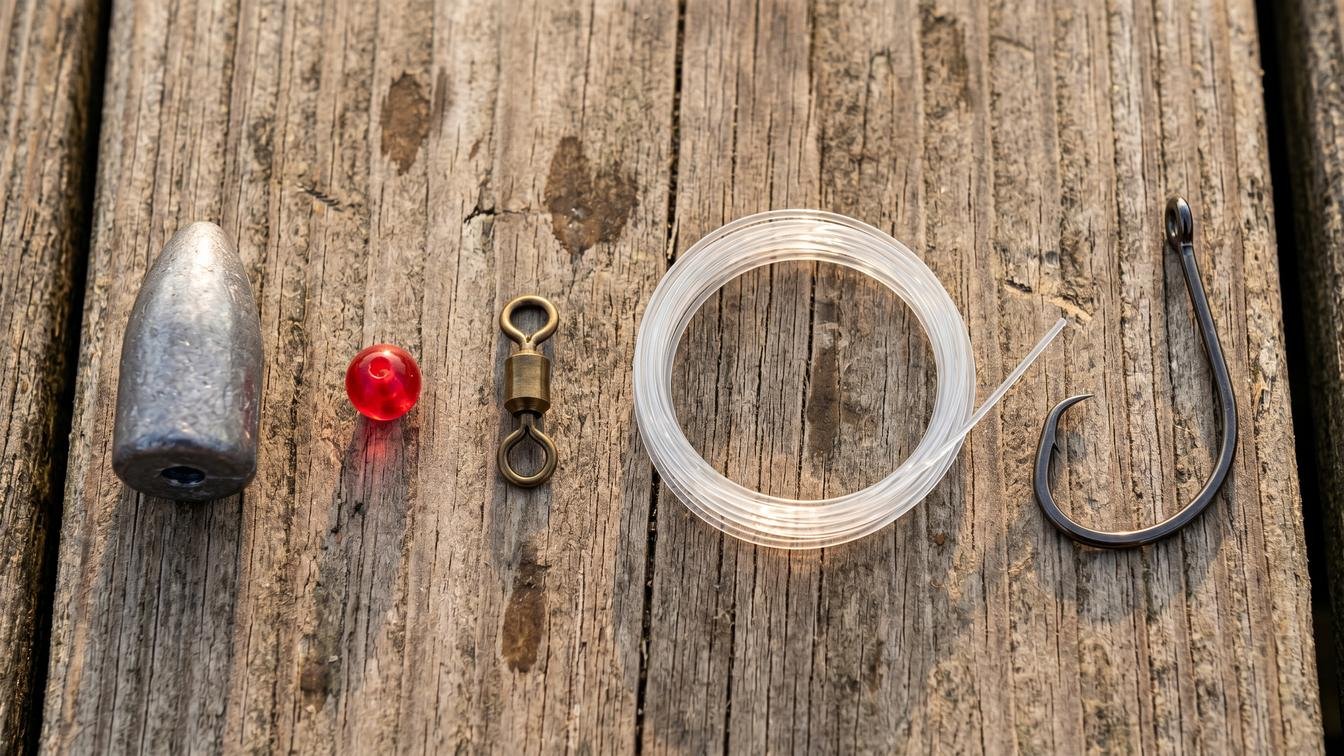
The slip sinker rig is your foundation. Master this one and you’ve got a tool that works from farm ponds to the Mississippi. Here’s exactly how to build it.
Components You’ll Need
- Mainline: 17-20 lb monofilament or 30-50 lb braided line
- Egg sinker: 1 oz for ponds and still water, 2 oz for moderate current, 3 oz for heavy current or deep water
- Bead (optional but recommended): 8mm plastic bead, sits between sinker and swivel to protect the knot
- Barrel swivel: Size 5 to size 1 (the higher the number, the smaller the swivel), rated for at least the breaking strength of your mainline
- Leader: 18-24 inches of 20-30 lb monofilament (use heavier fluorocarbon if fishing for blues or flatheads)
- Hook: 2/0 to 4/0 circle hook for channels, 5/0 to 8/0 for blues and flatheads
Step-by-Step Assembly
- Pull about 4 feet of mainline off your reel. This gives you room to work without fighting the rod tip.
- Thread your egg sinker onto the mainline. The sinker should slide freely up and down the line with no resistance.
- Slide a plastic bead onto the mainline after the sinker. The bead acts as a cushion that protects your knot from the sinker banging against it during casting and retrieval.
- Tie a barrel swivel to the end of your mainline using a Palomar knot or improved clinch knot. Wet the knot before cinching it down. The swivel stops the sinker from sliding any further and creates the pivot point of the rig.
- Cut a leader of 18 to 24 inches from your leader material. Longer leaders (24-30 inches) work better in clear, calm water where catfish are spooky. Shorter leaders (12-18 inches) work better in stained water and current.
- Tie one end of the leader to the open eye of the barrel swivel using the same knot you used in step 4.
- Tie a circle hook to the other end of the leader using a snell knot. The snell knot is critical because it positions the hook to roll out and find the corner of the fish’s mouth during the hookset. Avoid using a clinch or Palomar on a circle hook if you can help it.
- Bait the hook. Cut bait, chicken liver, prepared dough baits, or live bluegill are all proven choices. Match your bait to your target species (we cover this in detail in our guide to the best catfish bait for each species).
- Cast the rig and let it settle on the bottom. Open the bail or engage the clicker so the fish can take line without resistance.
- When a fish takes the bait and starts moving, do not jerk the rod. Reel down until the line comes tight, then lift steadily. The circle hook will rotate and set itself in the corner of the jaw.
When to Adjust the Setup
Heavier sinker in heavy current. If your sinker is drifting more than a few feet after settling, step up an ounce. If it’s anchored like a brick but you’re not getting bites, drop down an ounce so the bait moves more naturally.
Longer leader in clear water. Catfish in clear lakes get line-shy. Stretching the leader to 30 or even 36 inches puts more separation between your bait and the obvious hardware. Shorter leader in current or stained water keeps the bait closer to the fixed sinker so it doesn’t tumble out of the strike zone.
Bigger hook for bigger bait. If you’re running a whole 6-inch shad as cut bait, a 2/0 hook is too small. The hook gap needs to be wide enough to clear the bait and still find flesh on the hookset. Match hook size to bait size first, then to fish size.
Species-Specific Setup Recommendations
The three common catfish species in North American waters demand different setups. Here’s how to dial in for each.
Channel Catfish: The All-Rounder Setup
Channel catfish (Ictalurus punctatus) are the most widely distributed and most-fished species. They average 2 to 10 pounds in most waters, with trophies pushing 20+ pounds in big rivers and reservoirs.
For channels, run a 7-foot medium-heavy rod with moderate-fast action, a 4000 to 5000-size spinning reel or small baitcaster, and 15 to 20-pound monofilament. Your default rig is a slip sinker rig with a 1-ounce egg sinker, an 18-inch leader of 20-pound mono, and a 2/0 to 4/0 circle hook. Bait with cut shad, chicken liver, dough bait, nightcrawlers, or prepared stink baits.
This is the setup we suggest for anyone starting out, and it’s the same setup that puts plenty of dinner-sized channels in the cooler each summer.
Blue Catfish: The Heavy-Line Setup
Blue catfish (Ictalurus furcatus) are the giants. Trophy blues regularly top 50 pounds, and the world record sits above 140. They prefer big rivers and reservoirs with current and structure.
Step everything up for blues. Use a 7’6″ to 8′ heavy power rod with moderate-fast action, a round baitcaster like an Abu 7000-series with a clicker, and 30 to 65-pound braided mainline with a 40 to 60-pound mono or fluorocarbon leader. Your go-to rig is a slip sinker rig with a 2 to 3-ounce egg sinker, a 24-inch leader, and a 6/0 to 8/0 circle hook. In current, switch to a three-way rig with a 4 to 6-ounce bell sinker.
Bait choice for blues is almost exclusively cut bait or live shad. The bigger the bait, the bigger the average fish.
Flathead Catfish: The Live-Bait Setup
Flathead catfish (Pylodictis olivaris) are ambush predators. Unlike channels and blues, which will scavenge dead bait and stink baits, flatheads strongly prefer live, lively bait. They lay up in heavy cover like log jams, root wads, and undercut banks.
Run a 7’6″ to 8′ heavy power rod (some flathead specialists go even heavier), a round baitcaster, and 50 to 80-pound braided line with a 50 to 80-pound mono leader. Your rig is either a free-line rig (no sinker) for slack water or a slip sinker rig with a 1 to 2-ounce sinker for moving water. Hook size runs 7/0 to 10/0 circle hooks. Bait with live bluegill, live bullhead, live shad, or large live shiners.
Flathead fishing rewards patience and heavy gear. You’re trying to pull a 40-pound fish out of a brush pile that’s been collecting current-borne debris for a decade. The system has to be strong end to end.
Common Setup Mistakes (and the Fix)
After years of helping new anglers troubleshoot their rigs, the same handful of mistakes show up over and over. Here’s how to avoid them.
Line Too Light for the Sinker
If you’re casting a 3-ounce sinker on 10-pound mono, you’re going to break off on the cast. The sinker’s momentum at the end of your casting stroke generates a shock load that exceeds the line’s breaking strength. As a rough rule, your line test (in pounds) should be at least 5 times the sinker weight (in ounces). A 2-ounce sinker wants 10-pound line minimum just to cast, and we’d suggest 17 to 20-pound for actual fishing.
Hook Size Mismatch
Hook size has to match the bait first, the fish second. A 2/0 hook buried in a chunk of cut shad the size of a deck of cards will never penetrate flesh on the hookset because there’s no exposed gap. A 10/0 hook with a single nightcrawler is too big to find purchase. Pick a hook where roughly half the bend is exposed below your bait, and the gap is at least twice the diameter of the bait.
Using Fast-Action Rod with Circle Hooks
This is the silent killer of catfish hookups. A fast-action rod has a stiff tip that doesn’t load smoothly. With a circle hook, you don’t snap-set on the bite. You let the fish pull the rod tip down, then reel into the fish while lifting steadily. A fast-action tip won’t bend smoothly through this motion. It snaps straight, pulling the hook out of the fish’s mouth before the circle has rotated into position. Moderate-fast action is what circle hooks were designed around.
Not Accounting for Current When Choosing Sinker Weight
An ounce of sinker that holds bottom in your local farm pond will slide for 30 feet in a tailwater. Current is the variable that gets ignored most often. Match your sinker to the water: 1 ounce for ponds and still backwaters, 2 ounces for slow rivers and breezy lakes, 3 ounces for moderate current, 4 to 6 ounces for heavy current or wind. If your bait isn’t sitting still on the bottom, you’re not fishing efficiently.
Bringing It Together
The whole point of a catfish setup is that everything connects. The rod has to handle the line weight. The line weight has to handle the rig weight. The rig has to handle the species. The hook has to match the bait. Get those four connections right and you’ve built a system that actually works.
If you’re shopping for gear and want to skip the trial-and-error phase, our recommended catfish combo picks bundle a rod and reel together that we’ve matched specifically for the rigs in this guide. Pair that with the slip sinker rig we walked through above, and you’ve got a complete system ready to fish.
Frequently Asked Questions
What is the best rig for catching catfish?
The slip sinker rig is the best all-around catfish rig and the one we suggest for 90% of situations. It allows the fish to take the bait and move off without feeling sinker resistance, which leads to better hookups, especially with circle hooks. In current you may switch to a three-way rig, and for big flatheads you’d use a free-line rig, but the slip sinker should be your default starting point.
What size hook should I use for catfish?
Hook size depends on the species and the bait you’re using. For channel catfish, a 2/0 to 4/0 circle hook covers most situations with cut bait, chicken liver, or dough bait. For blue catfish, step up to 5/0 to 8/0 circle hooks paired with larger cut bait or live shad. For flathead catfish using live bluegill or large shiners, run 7/0 to 10/0 circle hooks.
What pound test line is best for catfish?
Channel catfish in most waters fish well on 15 to 20-pound monofilament or 20 to 30-pound braid. Blue catfish demand heavier line, generally 30 to 65-pound braid with a 40 to 60-pound leader. Flathead catfish in heavy cover call for 50 to 80-pound braided mainline. Sizing your line up also helps you cast heavier sinkers without breakoffs on the cast.
What rod length is best for catfishing?
For most catfish situations, a 7-foot to 8-foot rod is ideal. The longer length provides casting distance from the bank, leverage against big fish, and the room to bend through moderate-fast action when fighting fish. Drop down to 6’6″ to 7′ for smaller channels in tight quarters, or step up to 8’+ for trophy blues and flatheads where extra length helps pull fish away from cover.
What is the difference between a slip sinker rig and a three-way rig?
A slip sinker rig has the sinker sliding freely on the mainline above a barrel swivel, with the leader and hook below. The sliding sinker lets the fish take the bait without feeling weight. A three-way rig uses a three-way swivel to separate the sinker (on a short dropper) from the leader and hook, which keeps the bait suspended above the bottom and anchors the rig in current. Use slip sinker in still water and three-way when current is the dominant factor.
Can you use a spinning reel for catfish?
Yes, spinning reels work well for catfish, especially for channel catfish and smaller blues up to about 15 to 20 pounds. Use a 4000 to 6000-size reel with a strong drag and ideally a bait-feeder feature that lets line run freely until you flip the bail. For trophy blues and flatheads in heavy cover, a baitcaster offers more cranking power, but spinning gear is perfectly capable for most situations.
What is the best catfish setup for bank fishing?
For bank fishing, we suggest a 7’6″ to 8′ medium-heavy rod with moderate-fast action, a 5000-size spinning reel or round baitcaster, 17 to 20-pound monofilament mainline, and a slip sinker rig with a 1 to 2-ounce egg sinker, an 18 to 24-inch leader, and a 3/0 circle hook. The longer rod helps you cast farther from the bank, and the slip sinker rig lets you set the rod in a holder and wait for the bite without spooking the fish.